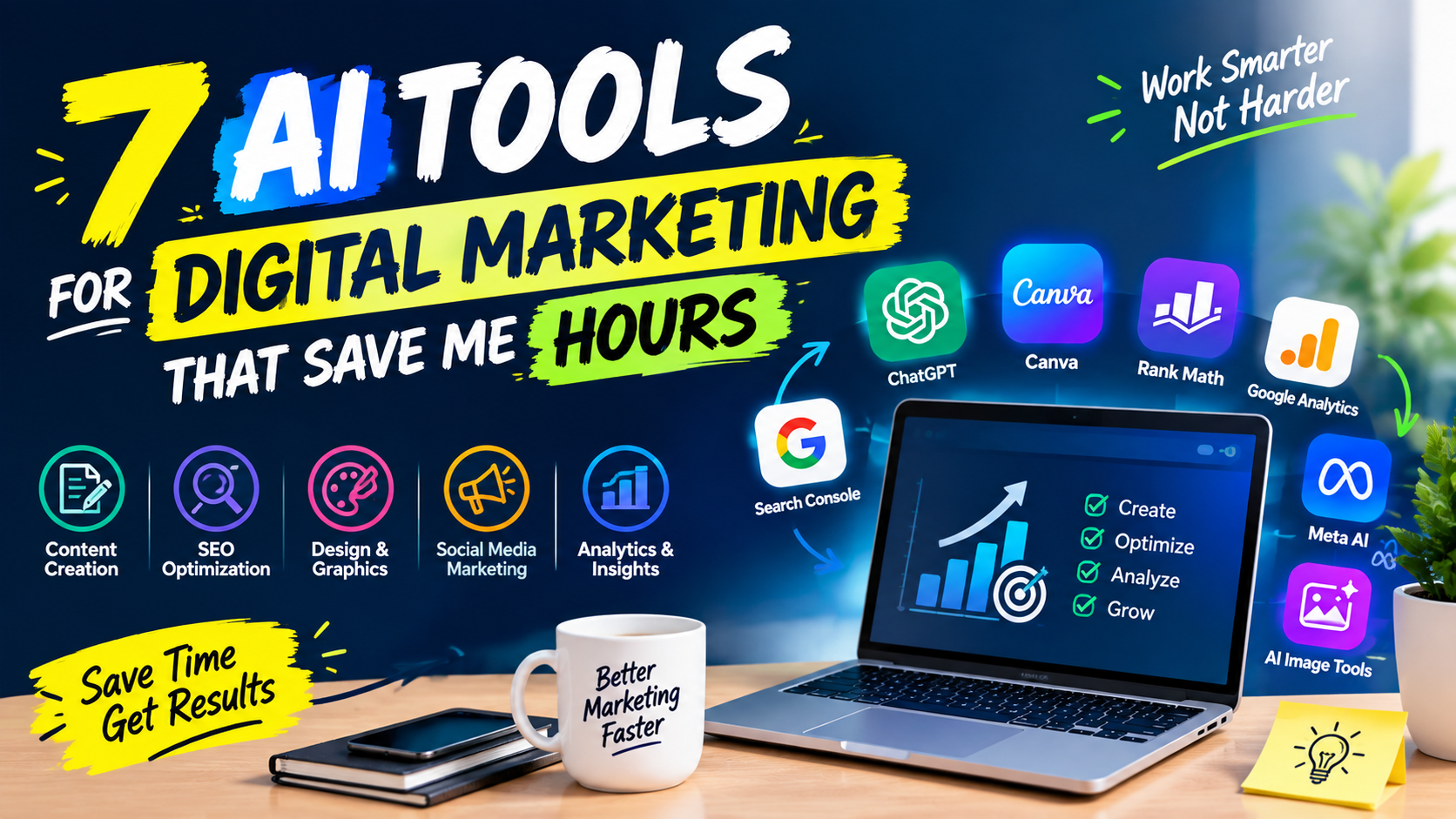
7 AI Tools for Digital Marketing That Save Me Hours
Digital marketing can easily turn into a full-day job.
One minute you're researching keywords. Then you're writing content, creating social media posts, designing graphics, checking analytics, analyzing competitors, optimizing SEO, and finally wondering where the entire day went.
That's where AI tools for digital marketing have completely changed the way I work.
Instead of using AI simply to generate random content, I use it as a productivity layer across different parts of my workflow. The goal isn't to replace creativity or strategy. The goal is to remove repetitive work so I can spend more time on decisions that actually matter.
After experimenting with different AI and marketing tools, these are 7 AI tools that can save marketers hours of work every week.
What Are AI Tools for Digital Marketing?
AI tools for digital marketing are software platforms that use artificial intelligence to help marketers perform tasks such as content creation, keyword research, graphic design, data analysis, customer research, campaign optimization, and automation.
The biggest advantage isn't necessarily that AI can "do marketing for you."
It's that AI can help you move from a blank page to a usable first draft, insight, design, or analysis much faster.
That can make a huge difference when you're managing multiple marketing channels at once.
1. ChatGPT – My AI Assistant for Marketing Work
If I had to choose one general-purpose AI tool for digital marketing, ChatGPT would be near the top of my list.
I use it for much more than writing articles.
It can help with:
Blog ideas
Content outlines
SEO content planning
Social media captions
Ad copy
Email drafts
Marketing strategies
Keyword clustering
Competitor analysis frameworks
JavaScript and HTML assistance
Content repurposing
Brainstorming
Research planning
Data interpretation
A/B testing ideas
The biggest productivity gain comes from using ChatGPT as a thinking partner rather than simply asking it to "write a blog."
For example, instead of starting with:
Write a blog about Meta Ads.
I can provide the target audience, search intent, existing content, product, objective, keywords and tone.
That produces a much more useful starting point.
How I use ChatGPT in digital marketing
My workflow is usually:
Idea → Research → Strategy → Outline → Draft → Optimization → Repurposing
AI can help accelerate almost every stage.
But I still review the final output myself.
That's important because AI-generated content can contain incorrect information, repetitive language, or generic recommendations.
Best for:
Content strategy, brainstorming, copywriting, SEO planning and productivity.
2. Canva – AI-Powered Design and Content Creation
Marketing isn't just about words.
Every campaign needs visuals.
Social posts, thumbnails, banners, presentations, advertisements and website graphics can consume a ridiculous amount of time if everything is created manually.
That's why Canva is one of my go-to tools.
Canva's Magic Studio includes AI-powered features for generating designs, writing, image editing, content transformation and other creative tasks. Canva also provides tools such as Magic Design, Magic Write, Magic Edit and Magic Switch.
For a digital marketer, this can significantly reduce the time required to move from an idea to a visual asset.
I use Canva for:
LinkedIn graphics
Instagram posts
Blog thumbnails
YouTube thumbnails
Ad creatives
Presentations
Infographics
Promotional banners
Social media campaigns
One feature I particularly like is the ability to transform existing content into different formats.
For example:
Blog → LinkedIn post → Instagram graphic → presentation → promotional visual
That means one piece of content can become multiple marketing assets.
Best for:
Social media design, marketing graphics, presentations and visual content.
3. Google Analytics – AI-Powered Marketing Insights
Creating traffic is only half the job.
You also need to understand what visitors are doing.
That's where analytics becomes important.
Google Analytics can use Google AI to identify insights and opportunities within your data, helping marketers find patterns that might otherwise take longer to discover manually.
Instead of looking at hundreds of numbers individually, marketers can use analytics insights to investigate questions such as:
Which pages are getting traffic?
Which campaigns generate conversions?
Where are users dropping off?
Which audiences are more valuable?
Which channels are performing better?
Are purchases increasing?
Which traffic sources deserve more attention?
Why this saves me time
Marketing decisions should be based on data.
But manually digging through analytics reports can become repetitive.
AI-powered insights can help surface potential patterns faster.
The important part is what happens next:
AI identifies a signal → I investigate the signal → I decide what action to take.
AI shouldn't blindly make the marketing decision.
Best for:
Analytics, campaign measurement, audience insights and data-driven marketing.
4. Rank Math – AI-Assisted SEO Optimization
SEO can become extremely time-consuming when you're managing multiple articles.
You need to think about:
Focus keywords
SEO titles
Meta descriptions
Headings
Internal links
External links
Readability
Content structure
Keyword placement
Search intent
That's where Rank Math becomes useful.
Rank Math's SEO analysis checks different on-page SEO factors and provides recommendations around keywords, metadata, links, readability and other optimization areas.
It also provides Content AI features that can assist with content optimization.
My basic workflow
I start with:
Keyword → Search intent → Outline → Content → Rank Math optimization
Then I check whether the focus keyword appears naturally in important areas such as the title, meta description, URL and introduction.
For example, the focus keyword for this article is:
AI tools for digital marketing
That keyword can naturally appear in:
SEO title
URL
Introduction
H2 headings
Body content
Meta description
Rank Math specifically checks several of these elements as part of its SEO tests.
Important SEO lesson
Don't write an article just to make an SEO plugin score green.
A green score is useful as a checklist, but search intent and content quality still matter more than stuffing keywords everywhere.
Best for:
On-page SEO, WordPress optimization and content optimization.
5. Google Search Console – Finding Real Search Opportunities
Google Search Console isn't traditionally marketed as an AI writing tool, but it's one of the most important tools in my SEO workflow.
Why?
Because it tells me what Google users are actually searching for.
Instead of guessing what keywords might work, I can look at real search performance.
I use it to monitor:
Search queries
Impressions
Clicks
CTR
Average position
Indexed pages
Indexing issues
Sitemap status
Search performance
One of my favorite SEO opportunities
Look for keywords where your page is already getting impressions but has a relatively low position or CTR.
For example:
A page might be getting:
10,000 impressions → 150 clicks
That doesn't automatically mean the article is bad.
It could mean the title or search snippet isn't compelling enough.
You can then test:
New title → better search intent match → improved CTR → more organic traffic
That's much more valuable than blindly publishing another 20 articles.
Best for:
SEO research, indexing, search performance and finding content opportunities.
6. Meta AI Tools – Faster Social Media and Advertising Work
Social media marketing involves a lot of repetitive work.
You may need to create:
Multiple ad variations
Headlines
Primary text
Creative concepts
Audience ideas
Campaign variations
Social posts
Content ideas
AI can help accelerate these processes.
Meta's ecosystem increasingly uses AI across advertising and content experiences, making AI-assisted workflows particularly useful for marketers running campaigns on Facebook and Instagram.
The biggest advantage is variation.
Instead of manually creating five versions of an advertisement, AI can help generate different angles that you can then review and refine.
For example:
Version A – Problem focused
"Still struggling to generate leads?"
Version B – Benefit focused
"Generate more qualified leads with a smarter marketing strategy."
Version C – Curiosity focused
"Your competitors may already be using this."
The marketer still needs to decide which message makes sense for the audience.
AI simply makes testing more efficient.
Best for:
Social media marketing, ad copy, creative ideas and campaign variations.
7. AI Image and Content Generation Tools – Faster Creative Production
One of the biggest changes in digital marketing is the speed at which visual content can now be produced.
AI image-generation and editing tools can help marketers create:
Campaign concepts
Blog illustrations
Social media visuals
Backgrounds
Product concepts
Creative variations
Promotional graphics
This becomes especially useful when you need to test multiple creative directions quickly.
Instead of spending hours searching for the perfect visual, you can generate a concept and then refine it.
Tools such as Canva's AI-powered features can also combine generation and editing inside the same workflow. Canva's Magic Media, for example, supports AI-generated visual content, while other Magic Studio features assist with editing and content transformation.
Best for:
Visual marketing, creative testing, thumbnails and campaign assets.
How I Combine These AI Tools Into One Marketing Workflow
The real productivity boost doesn't come from using seven tools separately.
It comes from connecting them.
Here's a simple workflow I use:
Step 1: Find the opportunity
Use Google Search Console and other SEO research methods to identify topics, queries and pages worth improving.
↓
Step 2: Build the strategy
Use ChatGPT to brainstorm content angles, audience pain points, article structures and campaign ideas.
↓
Step 3: Create the content
Use ChatGPT to build the first draft and supporting copy.
↓
Step 4: Optimize for SEO
Use Rank Math to check the article's SEO structure, keyword placement, metadata and readability.
↓
Step 5: Create visuals
Use Canva and AI-powered creative tools to create thumbnails, social posts and promotional assets.
↓
Step 6: Promote
Use social platforms and advertising tools to distribute the content.
↓
Step 7: Measure
Use Google Analytics and Search Console to understand what happened.
↓
Step 8: Improve
Take the data back into the workflow and create the next iteration.
That's the real power of AI.
It's not:
"AI writes everything."
It's:
"AI helps me iterate faster."
How Much Time Can AI Actually Save?
The answer depends on your workflow.
If you previously spent:
2 hours researching
3 hours writing
1 hour designing
1 hour creating social posts
1 hour analyzing data
you could potentially reduce the time spent on repetitive parts of those tasks significantly.
But I wouldn't promise that AI will magically turn an eight-hour workflow into a 30-minute workflow.
The actual benefit depends on:
Your prompts
Your experience
The complexity of the task
The quality of your inputs
How much editing is required
The tools you're using
Your marketing strategy
The biggest productivity improvement usually comes from reducing repetitive work, not eliminating human involvement.
AI Won't Replace Digital Marketers
This is probably the most important point.
AI can generate text.
AI can generate images.
AI can analyze data.
AI can suggest ideas.
But marketing isn't just about producing things.
Marketing requires understanding:
People → Problems → Positioning → Psychology → Strategy → Distribution → Data
A tool can help with these processes, but someone still needs to understand why a campaign should exist in the first place.
That's why I see AI as a marketing multiplier, not a replacement for marketers.
My AI Marketing Stack
If I had to simplify my workflow, it would look something like this:
| Task | Tool |
|---|---|
| Brainstorming | ChatGPT |
| Content creation | ChatGPT |
| SEO optimization | Rank Math |
| Search performance | Google Search Console |
| Analytics | Google Analytics |
| Graphic design | Canva |
| Social/ad creative | AI + Meta tools |
| Content repurposing | ChatGPT + Canva |
| Data-driven improvement | Analytics + Search Console |
You don't necessarily need every tool.
Start with the areas where you're losing the most time.
If writing takes too long, start with AI writing assistance.
If design takes too long, use AI-powered design tools.
If SEO analysis takes too long, improve your SEO workflow.
If reporting takes too long, automate your analytics process.
Final Thoughts
The biggest mistake marketers can make with AI is using it just because it's trendy.
The better approach is to ask:
"What repetitive task is wasting my time?"
Then find an AI tool that can reduce that workload.
For me, the biggest value comes from combining multiple tools into one workflow:
Research → Strategy → Create → Optimize → Design → Publish → Measure → Improve
AI makes that loop faster.
And when you're publishing content, running campaigns, managing social media and analyzing performance at the same time, saving even a few hours every week can compound into a huge productivity advantage.
The future of digital marketing isn't humans versus AI.
It's marketers who know how to use AI effectively versus marketers who don't.
So don't try to automate everything.
Start by automating the boring stuff.
Then use the extra time to think bigger.
Frequently Asked Questions
What are the best AI tools for digital marketing?
Some useful AI tools for digital marketing include ChatGPT for content and strategy, Canva for visual creation, Rank Math for SEO optimization, Google Analytics for data insights, Google Search Console for search performance, and AI-powered advertising tools for campaign creation.
How can AI help digital marketers?
AI can help digital marketers with content creation, brainstorming, SEO optimization, data analysis, ad copy, social media content, image creation, research and repetitive marketing tasks.
Can AI replace digital marketers?
No. AI can automate and accelerate many marketing tasks, but human strategy, creativity, audience understanding, positioning and decision-making remain important.
Is AI-generated content good for SEO?
AI-generated content can be useful when it provides original, accurate and genuinely helpful information. Simply generating large amounts of low-quality content is not a sustainable SEO strategy.
Which AI tool should a beginner use for digital marketing?
For beginners, a general-purpose AI assistant such as ChatGPT is a good starting point because it can help with brainstorming, content, research frameworks, marketing ideas and learning.
How can I use AI to save time in digital marketing?
Start by identifying repetitive tasks such as creating content variations, designing social posts, summarizing data, generating ideas or optimizing metadata. Then use AI to accelerate those tasks while keeping human review and strategic decision-making in the workflow.