What I Learned After Running a Custom-Domain Blogger Website
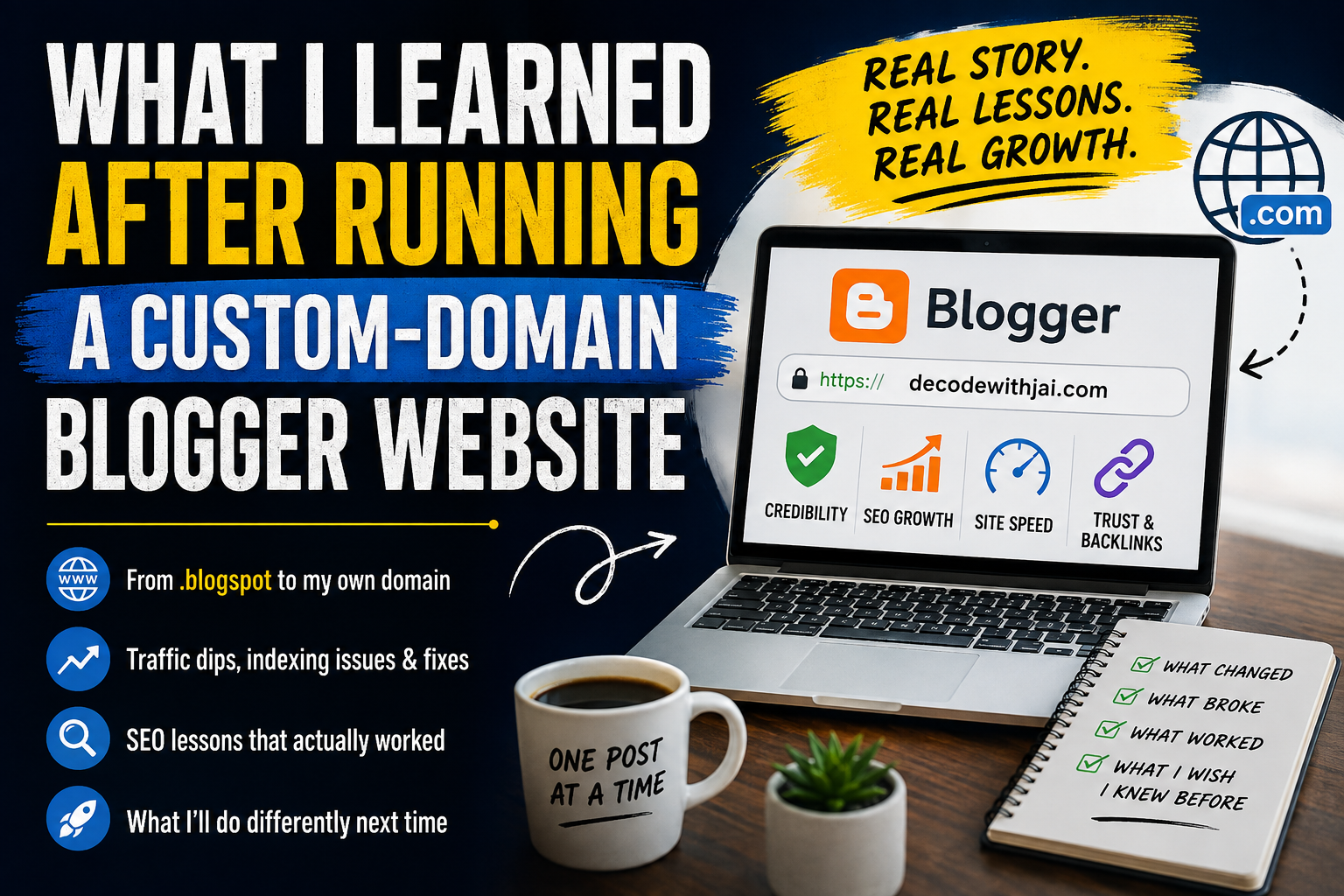
It was a Tuesday night, somewhere close to midnight, when I finally clicked "Save" on the domain settings page inside Blogger.
For weeks, my blog had been living at a free .blogspot.com address. It worked. It got a few visitors. But every time I shared a link with a client or a friend, there was this tiny, nagging voice in my head: this doesn't look like a real website.
So I bought a domain. Typed in the CNAME records. Waited for that dreaded "DNS propagation" message to disappear. And when the site finally loaded on my own .com, I remember just... staring at the screen. It felt like the blog had grown up overnight.
What I didn't expect was everything that came after that moment — the traffic dips, the indexing panic, the SEO lessons, and the small habits that quietly turned a hobby blog into something people actually search for and land on.
This is that story.
The Day the Blog "Grew Up" — And Then Got Scared
Connecting a custom domain to Blogger sounds simple on paper. Buy the domain, add a few DNS records, wait, done. Nobody tells you what happens in between.
Within 48 hours of switching, my traffic didn't rise — it fell. Almost to zero. I refreshed Google Search Console every hour like it was a cricket scoreboard, watching impressions crawl instead of climb.
Here's what I learned the hard way: when you move from a subdomain to a custom domain, Google treats it as a completely new website until it re-indexes everything. Every blog post I'd written now technically lived at a new URL. Old backlinks pointed to a dead end. Old rankings reset to zero.
If I could go back and whisper one thing into my own ear that night, it would be this: submit your new sitemap to Search Console immediately, and don't panic for the first two weeks. Indexing takes time, but it does come back — usually stronger.
Lesson One: A Custom Domain Is Credibility, Not Just Cosmetics
I used to think buying a domain was mostly about looking "professional." A nicer URL, a cleaner logo in the address bar. That's part of it — but it's not the real reason it matters.
A custom domain builds trust signals that a free subdomain simply can't:
- Brand recall — people remember "decodewithjai.com" far more easily than a long blogspot URL.
- Backlink value — other websites are noticeably more willing to link to a proper domain than to a free platform address.
- Ad and monetization approvals — several ad networks and affiliate programs are quietly stricter (or outright unavailable) for subdomain-based blogs.
If you're running a blog on Blogger and wondering whether the domain purchase is "worth it" — from someone who's lived both sides, it is. It's one of the cheapest credibility upgrades in content marketing.
Lesson Two: SEO Doesn't Start After You Publish — It Starts Before
Before running my own domain, I treated SEO like a checklist I filled out after writing a post: add a title, sprinkle a keyword, done.
Running a real domain changed that completely, because now every post had a shot at actually ranking — and ranking meant I had to stop guessing.
A few habits that made the biggest difference:
- Search intent first, keyword second. I stopped asking "what keyword should I target" and started asking "what is the person actually trying to find when they type this?" The keyword usually falls into place naturally once the intent is clear.
- One clear H1, structured H2s. Blogger themes don't always handle heading hierarchy well by default — I had to check this manually, post by post.
- Internal linking became a real strategy, not an afterthought. Every new post links back to two or three older, relevant posts. This alone noticeably improved how long people stayed on the site.
- Meta descriptions are still worth writing by hand. Auto-generated snippets rarely say what actually makes someone click.
None of this is exotic advice. But doing it consistently, post after post, is what separates a blog that ranks from one that quietly sits on page seven of Google forever.
Lesson Three: Site Speed and Theme Choices Matter More on Blogger Than People Admit
Blogger gets a bad reputation in some circles for being "outdated," but the truth is more nuanced — a lot of the slowness people blame on the platform actually comes from bloated, poorly-coded themes.
After digging deep into my own theme's code — cleaning up unused scripts, fixing render-blocking elements, and auditing widgets that were quietly slowing things down — page speed improved in a way that also nudged rankings upward. Google has been fairly open about page experience being part of how it evaluates sites, and it showed.
The lesson here: your theme is not just a design choice, it's an SEO decision. A beautiful theme that loads slowly will lose you both readers and rankings.
Lesson Four: Consistency Beats Intensity
There was a phase where I published five posts in one week, then nothing for a month. Traffic during that quiet month didn't just plateau — it dropped.
Compare that to the months where I published one well-researched, well-structured post every week, without fail. Slower, but steadier. And steadier, it turns out, is exactly what search engines seem to reward — a blog that shows up regularly signals it's active and worth crawling often.
This is the part nobody wants to hear because it's not glamorous: the blogs that win long-term aren't always the most brilliant ones — they're the most consistent ones.
Lesson Five: Analytics Tell a Story, If You Actually Read Them
For the first few months, I treated Google Analytics and Search Console like decoration — I'd glance at the total visitor number and close the tab.
Everything changed once I started reading the story behind the numbers instead of just the headline count:
- Which posts people found through search vs. social
- Where readers dropped off within a post
- Which "low effort" post accidentally became the top traffic driver
That last one taught me something humbling — one of my simplest, most practical posts (not the one I was proudest of) ended up bringing in the most organic search traffic, month after month. Readers don't always want your most polished writing. Sometimes they just want the answer to a very specific, very practical question.
The Real Takeaway
Running a custom-domain Blogger website taught me that a blog isn't really "finished" the moment you connect a domain — that's just the moment it starts being tested for real, in front of real search engines and real readers.
The traffic dip taught me patience. The theme audit taught me that design and performance are inseparable from SEO. The analytics taught me to listen to readers instead of my own assumptions. And the consistency lesson — that one I'm still practicing, one post at a time.
If you're sitting where I was that Tuesday night, staring at your own freshly connected domain, wondering if it was the right move — it was. The dip is temporary. The lessons aren't.