Meta Ads Scaling Strategies (2026): How to Scale Facebook & Instagram Ads Without Losing ROAS
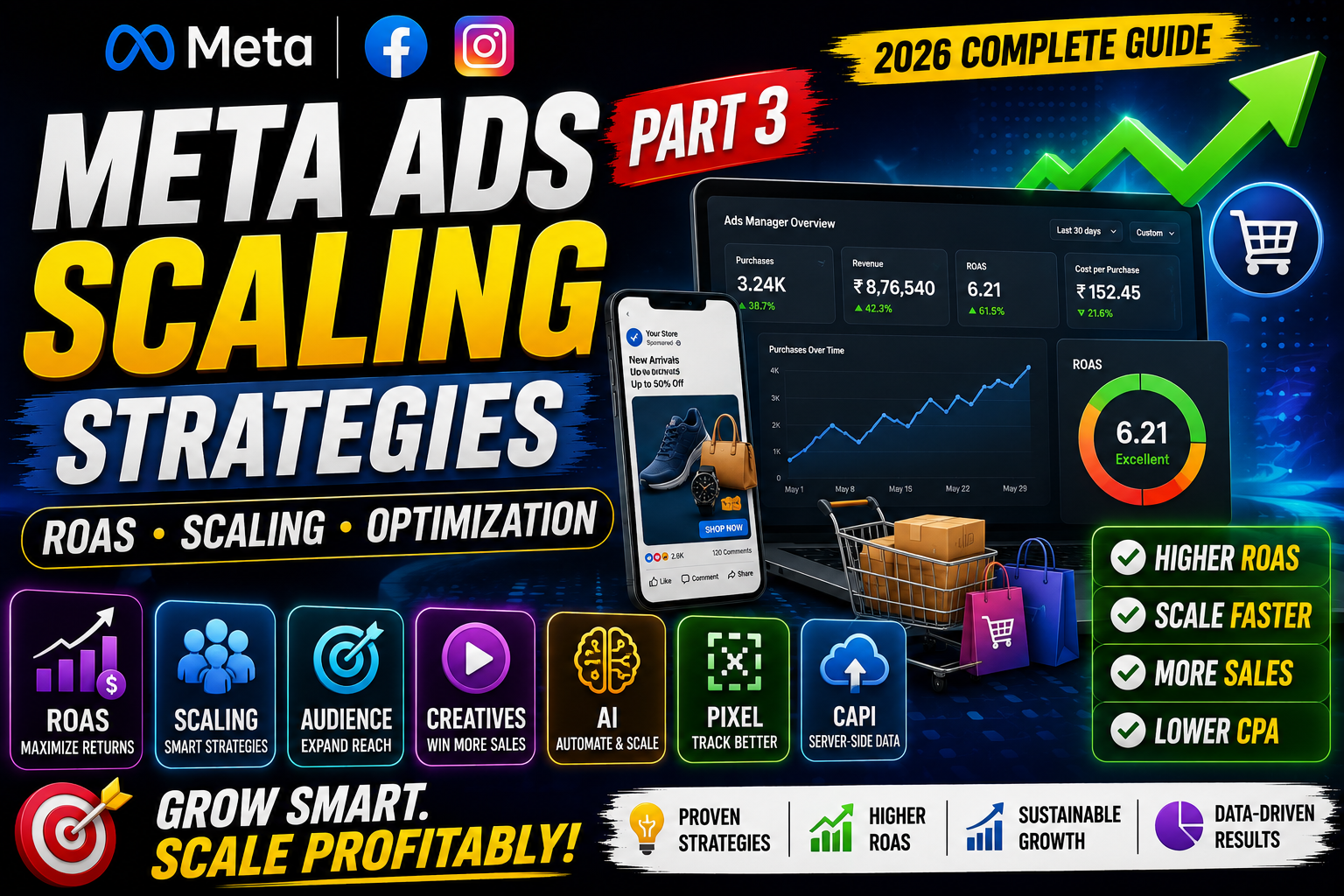
Meta Ads Scaling Strategies (2026): The Complete Guide to Growing Facebook & Instagram Ads Profitably
Launching a successful Meta Ads campaign is exciting, but the real challenge begins when it's time to scale. Many advertisers make the mistake of doubling their budget overnight, assuming more spending automatically means more sales. In reality, rapid scaling can increase your Cost Per Acquisition (CPA), reduce your Return on Ad Spend (ROAS), and push campaigns back into the learning phase.
Successful advertisers understand that scaling is a gradual, data-driven process. Instead of chasing bigger budgets, they focus on expanding audiences, improving creatives, optimizing landing pages, and making informed decisions based on campaign performance.
In this guide, you'll learn proven Meta Ads scaling strategies, ROAS optimization techniques, common mistakes to avoid, schema markup recommendations, internal linking ideas, and answers to frequently asked questions.
What Is Meta Ads Scaling?
Meta Ads scaling is the process of increasing the reach, conversions, and revenue of your Facebook and Instagram campaigns while maintaining profitability.
The objective isn't simply to spend more money—it's to generate more sales without significantly increasing advertising costs.
Effective scaling balances:
Higher reach
Better conversion rates
Stable CPA
Strong ROAS
Sustainable growth
When Should You Scale?
Don't scale based on a single successful day.
A campaign is generally ready when:
Conversion tracking is working correctly.
The campaign has exited the learning phase.
ROAS is consistently meeting your goals.
CPA is stable.
Frequency is under control.
Creative engagement remains healthy.
Scaling before these signals appear can reduce campaign efficiency.
Key Metrics to Monitor
| Metric | Why It Matters |
|---|---|
| ROAS | Measures profitability |
| CPA | Cost per acquisition |
| CTR | Indicates ad relevance |
| CPC | Measures click efficiency |
| Frequency | Helps detect ad fatigue |
| Conversion Rate | Landing page effectiveness |
| Cost Per Result | Overall campaign efficiency |
| Reach | Audience expansion |
| Impressions | Ad visibility |
Strategy 1: Vertical Scaling
Vertical scaling means increasing the budget of an existing successful campaign.
Best practices:
Increase budgets gradually rather than making large jumps.
Give campaigns time to stabilize after adjustments.
Monitor ROAS and CPA closely before making additional changes.
Strategy 2: Horizontal Scaling
Horizontal scaling expands successful campaigns instead of relying on one campaign.
Examples include:
Creating campaigns for new audience segments.
Testing different creative formats.
Targeting additional geographic locations.
Promoting new products or services.
Launching separate campaigns for different objectives.
This approach spreads risk and often uncovers new growth opportunities.
Strategy 3: Expand Your Audiences
Once a campaign performs well, carefully broaden your audience.
Useful audience strategies include:
Lookalike Audiences
Custom Audiences
Website Visitors
Video Viewers
Instagram Engagers
Existing Customers (where appropriate)
Always exclude audiences that have already converted when it aligns with your campaign goals.
Strategy 4: Refresh Your Creatives
Even the best-performing ad eventually experiences fatigue.
Refresh:
Images
Videos
Headlines
Primary Text
Call-to-Action
Ad Format
Introduce new variations regularly to maintain engagement.
Strategy 5: Leverage Advantage+ Campaigns
Meta's Advantage+ features can help automate parts of campaign delivery.
To get the most from automation:
Supply high-quality creative assets.
Use clear campaign objectives.
Review performance regularly.
Combine automation with strategic oversight.
Automation works best when supported by strong inputs.
Strategy 6: Optimize Your Budget
Budget allocation should be based on performance rather than assumptions.
Consider:
Increasing spend on consistently profitable campaigns.
Reducing investment in underperforming campaigns.
Monitoring seasonal demand.
Planning promotional periods in advance.
Avoid making multiple budget changes in a short period.
Strategy 7: Improve Landing Pages
A high-performing ad cannot compensate for a poor landing page.
Your landing page should:
Load quickly.
Match the ad message.
Be mobile-friendly.
Build trust with testimonials or reviews.
Include a clear call-to-action.
Better landing pages often improve conversion rates without increasing ad spend.
Strategy 8: Optimize for Higher ROAS
Return on Ad Spend (ROAS) is one of the most important metrics when scaling.
Ways to improve ROAS:
Improve Audience Quality
Target users who are more likely to convert rather than maximizing reach alone.
Optimize Creatives
Test different:
Headlines
Videos
Images
Offers
CTAs
Strengthen Conversion Tracking
Ensure Meta Pixel and Conversion API are correctly configured to improve measurement and optimization.
Increase Average Order Value
Encourage larger purchases through:
Product bundles
Upsells
Cross-sells
Limited-time offers
Focus on Customer Lifetime Value
Consider long-term customer value rather than only the first purchase when evaluating campaign performance.
Strategy 9: Use Automation Carefully
Automation can support scaling, but it shouldn't replace strategic thinking.
Continue to:
Review campaign reports.
Analyze audience behavior.
Refresh creatives.
Monitor business outcomes.
Common Scaling Mistakes
Avoid these errors:
Doubling budgets overnight.
Ignoring the learning phase.
Running outdated creatives.
Neglecting landing page optimization.
Overlapping audiences.
Tracking the wrong conversion events.
Optimizing too frequently.
Scaling campaigns that aren't consistently profitable.
Meta Ads Scaling Checklist
✅ Verify Meta Pixel tracking
✅ Configure Conversion API
✅ Confirm campaign stability
✅ Monitor ROAS
✅ Check CPA trends
✅ Refresh creatives
✅ Test new audiences
✅ Expand gradually
✅ Review landing pages
✅ Scale winning campaigns
Frequently Asked Questions
How much should I increase my Meta Ads budget?
Avoid dramatic increases. Scale gradually while monitoring campaign performance and allowing enough time for the system to adjust.
What is a good ROAS?
An acceptable ROAS depends on your business model, margins, and goals. Evaluate profitability rather than relying on a universal benchmark.
Should I duplicate campaigns when scaling?
Duplicating campaigns can be useful for testing different audiences, creatives, or strategies, but avoid creating unnecessary audience overlap.
Why did my ROAS drop after increasing my budget?
Possible reasons include entering the learning phase again, audience saturation, creative fatigue, increased competition, or reduced landing page performance.
Is Advantage+ good for scaling?
Advantage+ can support scaling when paired with high-quality creative assets, accurate tracking, and regular performance reviews.
Final Thoughts
Scaling Meta Ads successfully isn't about increasing budgets as quickly as possible—it's about expanding intelligently. Businesses that focus on accurate tracking, audience quality, compelling creatives, optimized landing pages, and continuous testing are more likely to achieve sustainable growth.
Treat scaling as an ongoing process rather than a one-time action. Measure results carefully, learn from your data, and make gradual improvements. Over time, this disciplined approach can help you increase conversions, protect your ROAS, and build campaigns that continue delivering value as your business grows.