Lead Generation Ads Guide (2026): Complete Beginner to Advanced Guide for More Leads & Higher Conversions
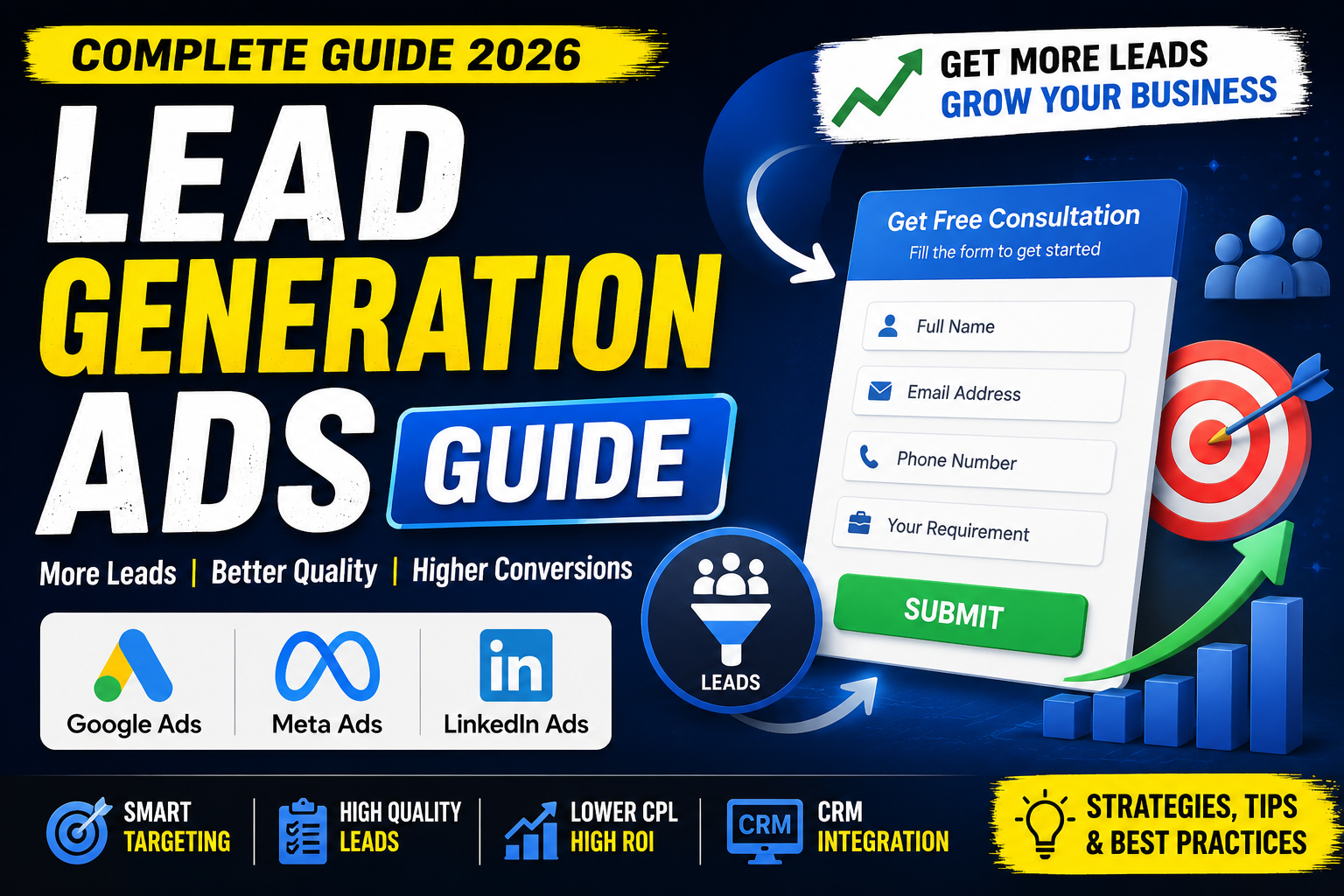
Lead Generation Ads Guide (2026): Everything You Need to Know
Imagine spending thousands of rupees on advertising only to receive unqualified leads that never answer your calls or emails. Frustrating, right?
Successful businesses don't just focus on getting clicks—they focus on generating high-quality leads that are likely to become paying customers.
That's where Lead Generation Ads come in.
Whether you're a local business, SaaS company, educational institute, real estate agency, healthcare provider, insurance consultant, or digital marketing agency, Lead Generation Ads help you collect customer information directly from interested prospects and move them into your sales pipeline.
In this comprehensive guide, you'll learn what Lead Generation Ads are, how they work, which platforms perform best, how to optimize campaigns, common mistakes to avoid, and proven strategies to maximize your return on investment (ROI).
Table of Contents
- What Are Lead Generation Ads?
- Why Businesses Use Lead Generation Ads
- How Lead Generation Ads Work
- Benefits of Lead Generation Ads
- Types of Lead Generation Ads
- Best Platforms for Lead Generation
- Google Ads Lead Generation
- Meta Lead Ads
- LinkedIn Lead Gen Forms
- Landing Pages vs Instant Forms
- Choosing the Right Campaign Objective
- Audience Targeting Strategies
- Creating High-Converting Ad Copy
- Optimizing Your Lead Forms
- Lead Scoring
- CRM Integration
- Lead Nurturing
- Measuring Performance
- Common Mistakes
- Best Practices
- Frequently Asked Questions
- Final Thoughts
What Are Lead Generation Ads?
Lead Generation Ads are digital advertisements designed to collect customer information such as:
- Name
- Email Address
- Phone Number
- Company Name
- Job Title
- Budget
- Business Requirements
Instead of focusing only on website traffic, these campaigns aim to capture valuable contact information from users who show genuine interest in your products or services.
Why Lead Generation Ads Matter
Every business needs a consistent flow of potential customers.
Lead Generation Ads help businesses:
- Generate qualified prospects
- Build customer databases
- Increase inquiries
- Book appointments
- Schedule demos
- Grow email lists
- Improve sales opportunities
Unlike traditional advertising, these campaigns allow you to measure every stage of the customer journey.
How Lead Generation Ads Work
The process is straightforward:
- A user sees your advertisement.
- They click the ad.
- A lead form or landing page opens.
- The user submits their information.
- The lead is stored in your CRM or advertising platform.
- Your sales team follows up with the prospect.
- Qualified leads become customers.
This streamlined journey reduces friction and increases conversion rates.
Benefits of Lead Generation Ads
Running Lead Generation Ads provides several advantages:
- Higher quality leads
- Faster customer acquisition
- Lower cost per lead (CPL)
- Better targeting
- Accurate conversion tracking
- Improved ROI
- Automated lead collection
- Easy CRM integration
- Better campaign optimization
- Scalable business growth
Types of Lead Generation Ads
Search Ads
Appear when users actively search for services like:
- Digital Marketing Agency
- Best Real Estate Agent
- Online MBA Course
These users already have purchase intent, making Search Ads highly effective.
Display Ads
Visual advertisements shown across websites, apps, and YouTube to increase brand awareness and attract potential leads.
Video Ads
Short videos on YouTube, Facebook, Instagram, and other platforms that educate, engage, and encourage users to submit their contact details.
Social Media Lead Ads
Platforms like Facebook, Instagram, and LinkedIn offer instant lead forms that users can complete without leaving the app.
Discovery & Demand Generation Ads
These visually engaging campaigns appear across Google properties and are designed to capture demand before users begin actively searching.
Best Platforms for Lead Generation
Google Ads
Ideal for capturing users with high purchase intent through Search, Performance Max, and Demand Gen campaigns.
Best for:
- Local services
- Home improvement
- Legal services
- Healthcare
- Education
- B2B software
Meta Ads (Facebook & Instagram)
Meta Lead Ads provide built-in forms that automatically populate user details, making it easy for people to submit inquiries.
Best for:
- Real Estate
- Coaching
- Fitness
- Events
- Ecommerce
- Local businesses
LinkedIn Ads
LinkedIn Lead Gen Forms are highly effective for B2B marketing and professional services.
Ideal for:
- SaaS
- Recruitment
- Consulting
- Enterprise software
- Corporate training
Landing Pages vs Instant Lead Forms
Instant Lead Forms
Advantages:
- Faster submissions
- Lower friction
- Mobile-friendly
- Lower cost per lead
Disadvantages:
- Sometimes lower lead quality
- Less opportunity to educate prospects
Landing Pages
Advantages:
- Better qualification
- Stronger branding
- More detailed information
- Higher-quality leads
Disadvantages:
- Slightly lower conversion rates
- Requires website optimization
For high-value services, landing pages often outperform instant forms in lead quality.
Choosing the Right Campaign Objective
Select an objective that aligns with your business goals:
- Lead Generation
- Website Conversions
- Phone Calls
- Appointment Bookings
- Demo Requests
- Newsletter Sign-ups
- Quote Requests
Clear objectives improve optimization and reporting.
Audience Targeting Strategies
Effective targeting includes:
- Geographic targeting
- Demographic filters
- Interests and behaviors
- In-market audiences
- Custom audiences
- Lookalike audiences
- Customer Match lists
- Remarketing audiences
The more relevant your audience, the better your campaign performance.
Writing High-Converting Ad Copy
Your ad should answer three questions:
Why should users care?
Highlight the main benefit.
Why should they trust you?
Include testimonials, ratings, awards, or years of experience.
What should they do next?
Use strong calls-to-action such as:
- Get Free Quote
- Book Free Consultation
- Schedule Demo
- Download Free Guide
- Start Today
Optimizing Your Lead Forms
Only ask for essential information.
Recommended fields:
- Full Name
- Phone Number
- Company Name (B2B)
- Business Type
- Service Required
Too many fields often reduce conversion rates.
Lead Scoring
Not every lead has equal value.
Assign scores based on:
- Budget
- Industry
- Company size
- Buying intent
- Job role
- Engagement level
Lead scoring helps sales teams prioritize follow-ups.
CRM Integration
Integrating your CRM ensures leads are automatically captured and managed.
Popular CRM platforms include:
- HubSpot
- Salesforce
- Zoho CRM
- Pipedrive
- Freshsales
Automation reduces response time and improves customer experience.
Lead Nurturing
Many leads are not ready to buy immediately.
Nurture them through:
- Email sequences
- SMS campaigns
- WhatsApp follow-ups
- Retargeting ads
- Educational content
- Product demonstrations
- Webinars
Consistent communication builds trust and increases conversions.
Measuring Campaign Performance
Track these key metrics:
| Metric | Why It Matters |
|---|---|
| Impressions | Ad visibility |
| Click-Through Rate (CTR) | Ad relevance |
| Cost Per Click (CPC) | Traffic cost |
| Cost Per Lead (CPL) | Lead acquisition efficiency |
| Conversion Rate | Form completion percentage |
| Lead Quality | Sales readiness |
| Return on Ad Spend (ROAS) | Campaign profitability |
| Customer Acquisition Cost (CAC) | Cost to acquire customers |
Review these metrics regularly to identify optimization opportunities.
Common Lead Generation Mistakes
Avoid these frequent errors:
- Targeting overly broad audiences
- Using weak calls-to-action
- Asking for too much information
- Ignoring mobile optimization
- Slow landing pages
- Failing to follow up quickly
- Not tracking conversions
- Sending all leads to sales without qualification
- Ignoring remarketing opportunities
- Never testing ad variations
Best Practices
- Define clear campaign goals.
- Match ads to user intent.
- Keep forms short and simple.
- Use compelling headlines and visuals.
- Test multiple creatives and audiences.
- Optimize landing pages for speed and clarity.
- Respond to new leads quickly.
- Integrate campaigns with a CRM.
- Analyze performance weekly.
- Continuously refine targeting and messaging.
Lead Generation Campaign Checklist
✅ Define your target audience
✅ Choose the right advertising platform
✅ Create compelling ad creatives
✅ Build a high-converting landing page or instant form
✅ Configure conversion tracking
✅ Connect your CRM
✅ Launch your campaign
✅ Monitor CPL and conversion rate
✅ Follow up with leads promptly
✅ Optimize campaigns regularly
Frequently Asked Questions
What are Lead Generation Ads?
Lead Generation Ads are campaigns designed to collect contact information from potential customers interested in your products or services.
Which platform is best for lead generation?
It depends on your business:
- Google Ads for high-intent searches
- Meta Ads for cost-effective social lead generation
- LinkedIn Ads for B2B professionals
What is a good Cost Per Lead (CPL)?
A good CPL varies by industry, competition, and customer value. Focus on lead quality and overall return on investment rather than cost alone.
Should I use instant forms or landing pages?
Instant forms generally produce more leads with less friction, while landing pages often generate higher-quality leads by providing more context and qualification.
How quickly should I contact a lead?
Respond as soon as possible—ideally within minutes or hours. Prompt follow-up increases the chances of converting interest into a sales conversation.
Final Thoughts
Lead Generation Ads remain one of the most effective ways to grow a business in 2026. Whether you're using Google Ads, Meta Ads, or LinkedIn Ads, success depends on reaching the right audience, delivering a compelling message, and making it easy for prospects to take the next step.
The best-performing campaigns don't stop at collecting contact details—they combine accurate tracking, CRM integration, lead nurturing, and continuous optimization to turn inquiries into loyal customers. By focusing on lead quality, fast follow-up, and data-driven improvements, you can build a predictable pipeline that supports long-term business growth.