Landing Page Optimization (2026): The Complete Guide to Increase Conversions & Maximize Google Ads ROI
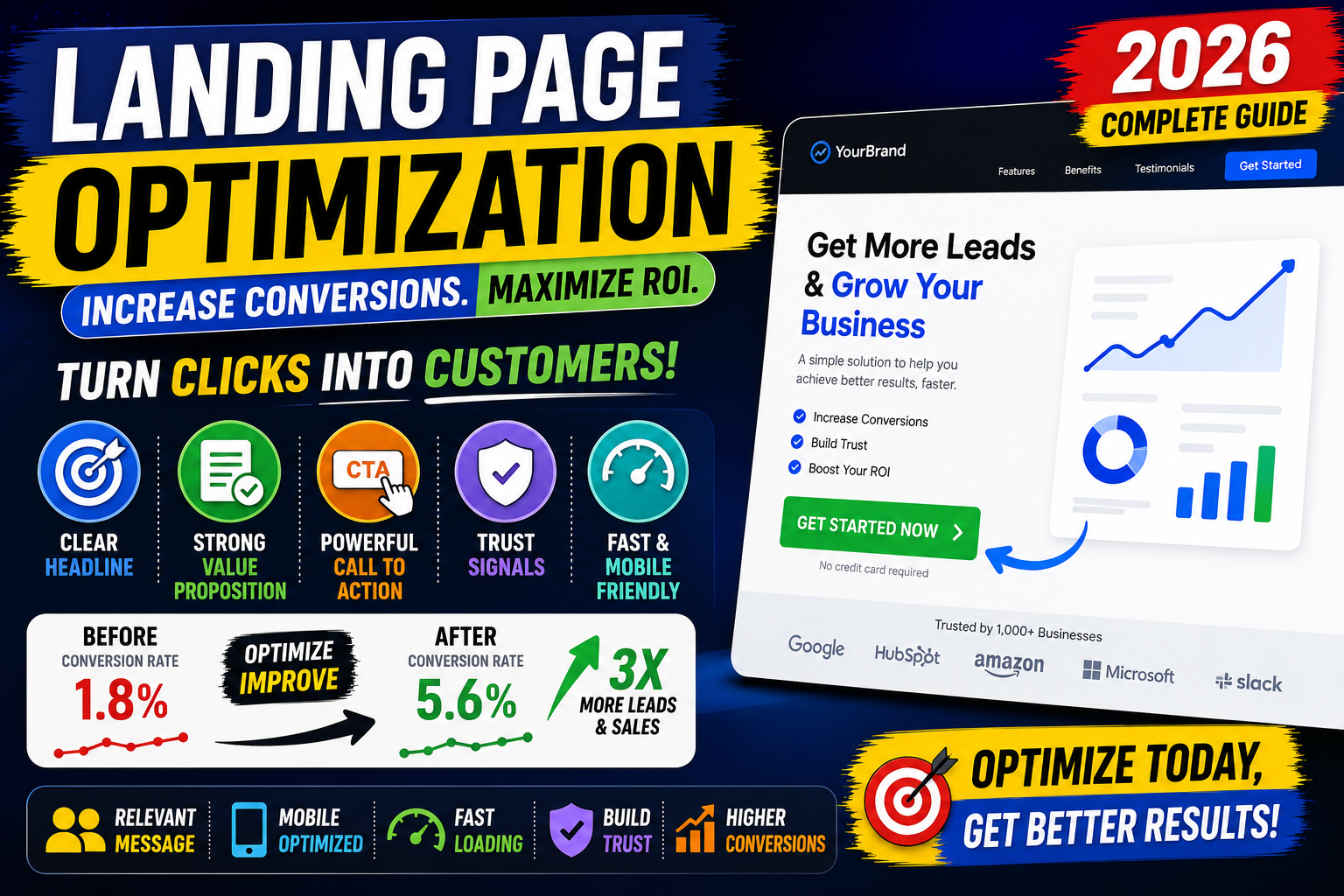
Driving traffic to your website is only half the battle. The real success of any Google Ads campaign depends on what happens after someone clicks your ad. If visitors leave without taking action, you're losing valuable opportunities—and your advertising budget.
This is where Landing Page Optimization (LPO) becomes essential.
A well-optimized landing page improves user experience, increases conversion rates, enhances Google Ads Quality Score, and helps lower your Cost Per Click (CPC). Whether your goal is generating leads, selling products, booking appointments, or collecting email subscribers, optimizing your landing page can significantly improve campaign performance.
In this complete guide, you'll learn everything about Landing Page Optimization, including best practices, design principles, conversion techniques, A/B testing, SEO considerations, and common mistakes to avoid.
Table of Contents
What is Landing Page Optimization?
Why Landing Pages Matter
Landing Page vs Homepage
Benefits of Landing Page Optimization
Key Elements of a High-Converting Landing Page
Writing High-Converting Headlines
Creating Effective Calls-to-Action
Improving Page Speed
Mobile Optimization
Trust Signals
Forms & Lead Generation
Images and Videos
A/B Testing
Landing Page SEO
Common Landing Page Mistakes
Landing Page Optimization Checklist
Frequently Asked Questions
Final Thoughts
What is Landing Page Optimization?
Landing Page Optimization (LPO) is the process of improving a landing page to increase the percentage of visitors who complete a desired action.
That action may include:
Purchasing a product
Filling out a contact form
Requesting a quote
Booking a consultation
Downloading an eBook
Registering for a webinar
Subscribing to a newsletter
Instead of focusing only on attracting more traffic, LPO focuses on getting more value from the traffic you already have.
Why Landing Pages Matter
Imagine paying for 1,000 clicks through Google Ads.
If your landing page converts only 2% of visitors, you'll generate 20 conversions.
Now imagine improving your landing page so it converts at 5%.
Without increasing your ad budget, those same 1,000 clicks now produce 50 conversions.
This demonstrates why landing page optimization is one of the highest-impact improvements you can make.
Landing Page vs Homepage
Many advertisers send paid traffic directly to their homepage, but a dedicated landing page usually performs better because it is focused on one specific goal.
| Homepage | Landing Page |
|---|---|
| Multiple navigation options | Single focused objective |
| General business information | Campaign-specific content |
| Multiple calls-to-action | One primary CTA |
| Designed for exploration | Designed for conversion |
Benefits of Landing Page Optimization
Optimizing your landing page can help you:
Increase conversion rates
Improve Google Ads Quality Score
Lower Cost Per Click (CPC)
Increase Return on Ad Spend (ROAS)
Reduce bounce rates
Improve user experience
Build trust with visitors
Generate more qualified leads
Essential Elements of a High-Converting Landing Page
1. A Clear Headline
Your headline is the first thing visitors notice.
A good headline should:
Clearly explain your offer
Match the message in your ad
Highlight the main benefit
Use simple, easy-to-understand language
2. A Strong Value Proposition
Tell visitors why they should choose your product or service.
Answer questions like:
What problem do you solve?
Why are you different?
What benefits will users receive?
3. High-Quality Visuals
Use relevant images or videos that support your message.
Examples include:
Product photos
Service demonstrations
Before-and-after examples
Explainer videos
Avoid stock images that don't add value or authenticity.
4. Clear Call-to-Action (CTA)
Your CTA should tell users exactly what to do next.
Examples:
Get Started
Request a Demo
Book a Free Consultation
Download Now
Buy Now
Use contrasting colors so the CTA stands out.
5. Fast Loading Speed
Page speed has a direct impact on user experience and conversions.
To improve speed:
Compress images
Minify CSS and JavaScript
Enable browser caching
Use a Content Delivery Network (CDN)
Reduce unnecessary plugins or scripts
6. Mobile-Friendly Design
A significant portion of paid traffic comes from mobile devices.
Ensure your landing page has:
Responsive layouts
Readable text
Large tap targets
Fast mobile loading
Simple navigation
7. Trust Signals
Visitors are more likely to convert when they trust your brand.
Consider including:
Customer testimonials
Ratings and reviews
Case studies
Client logos
Security badges
Certifications
Money-back guarantees (if applicable)
8. Simple Lead Forms
Long forms often reduce conversions.
Ask only for information you truly need.
For example:
Name
Email
Phone number
If more details are required, consider collecting them later in the sales process.
Improving Conversion Rates
Focus on reducing friction.
Ways to improve conversions:
Keep messaging clear
Highlight benefits over features
Remove unnecessary distractions
Make CTAs visible above the fold
Repeat key CTAs throughout the page
Address common objections
Landing Page and Google Ads Quality Score
Landing page experience is one of the core components of Google Ads Quality Score.
Google evaluates factors such as:
Relevance
Transparency
Navigation
Original content
Load speed
Mobile usability
Improving these elements can contribute to better campaign performance.
A/B Testing Your Landing Pages
Never assume your first version is the best.
Test different versions of:
Headlines
CTA text
Button colors
Images
Form length
Testimonials
Pricing presentation
Page layouts
Measure one change at a time so you can accurately identify what improves performance.
Landing Page SEO Best Practices
Even though landing pages are often built for paid campaigns, SEO best practices can improve visibility and user experience.
Consider:
Optimized title tags
Clear H1 headings
Descriptive meta descriptions
Internal links
Optimized images
Clean URLs
Fast page speed
Mobile responsiveness
Common Landing Page Mistakes
Avoid these common issues:
Sending users to the homepage
Slow loading pages
Weak headlines
Too much text
Multiple competing CTAs
Poor mobile experience
Missing trust signals
Long forms
Low-quality images
Inconsistent messaging between ads and landing pages
Landing Page Optimization Checklist
✅ Match your landing page with your ad
✅ Write a compelling headline
✅ Highlight a clear value proposition
✅ Add a strong CTA
✅ Optimize for mobile
✅ Improve page speed
✅ Include testimonials
✅ Simplify forms
✅ Test different versions
✅ Monitor conversion rates
Frequently Asked Questions
What is Landing Page Optimization?
Landing Page Optimization is the process of improving a page so more visitors complete a desired action, such as making a purchase or submitting a form.
Why is Landing Page Optimization important?
It helps increase conversions, improve user experience, and maximize the return on your advertising investment.
Does Landing Page Optimization affect Google Ads?
Yes. A better landing page experience can improve Quality Score, which may help lower CPC and improve ad performance.
How often should I test my landing page?
Regular testing is recommended, especially after major design changes or when campaign performance changes.
What is a good landing page conversion rate?
Conversion rates vary by industry, traffic source, and offer. The most useful benchmark is improving your own page over time through testing and optimization.
Final Thoughts
Landing Page Optimization is one of the most effective ways to improve the performance of your Google Ads campaigns. While attracting visitors is important, converting those visitors into customers is what ultimately drives business growth.
By creating focused, fast, mobile-friendly, and trustworthy landing pages—and by continuously testing and refining them—you can improve conversion rates, reduce wasted ad spend, and maximize your return on investment.
Optimization isn't a one-time task. It's an ongoing process of learning from data, testing new ideas, and delivering a better experience for every visitor.