Best Google Ads Strategies (2026): 25 Proven Strategies to Increase Leads, Sales & ROI
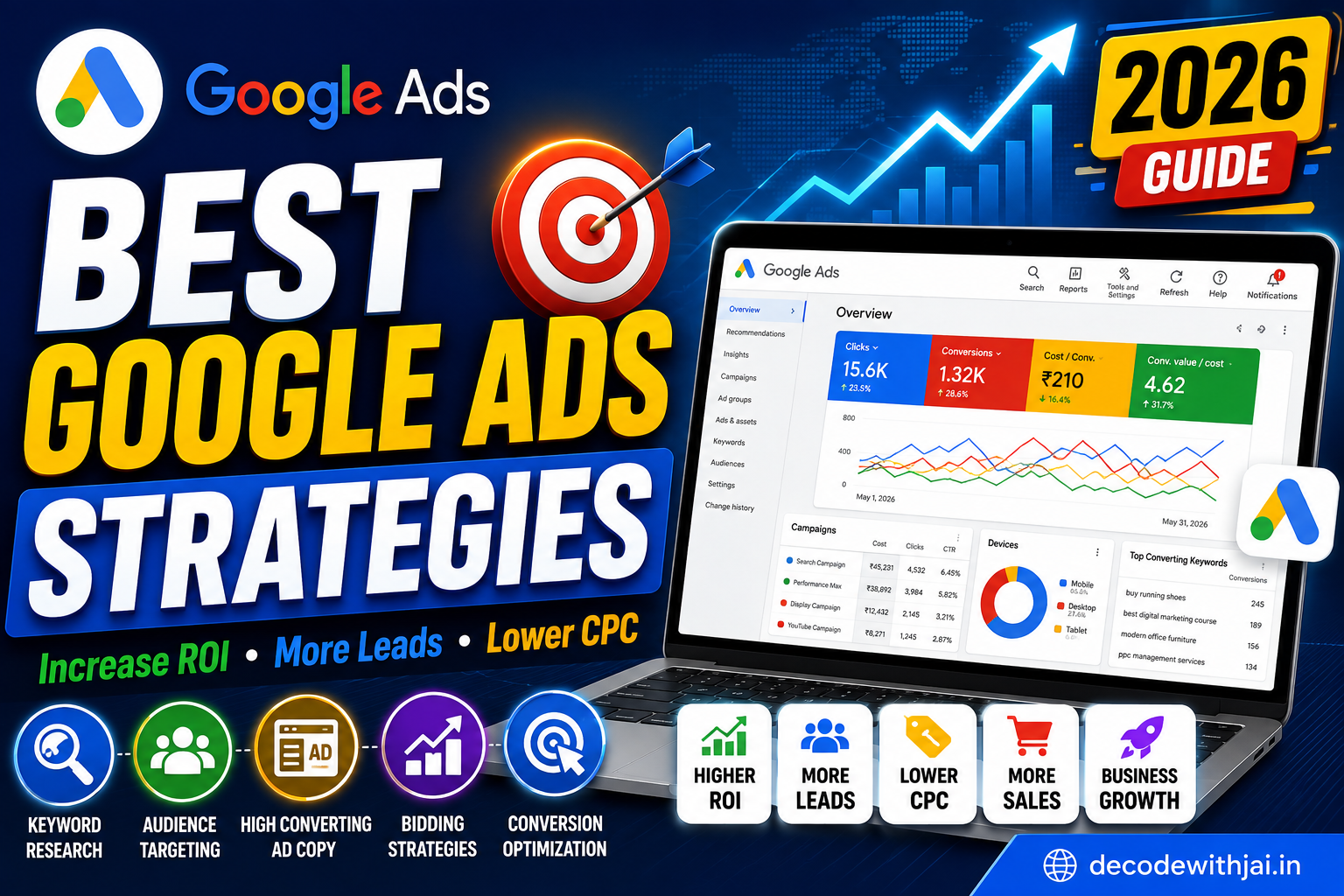
Best Google Ads Strategies (2026): The Complete Guide to Higher ROI & Better Conversions
Google Ads is one of the most powerful digital advertising platforms for businesses looking to generate qualified leads, increase online sales, and grow brand visibility. Every day, millions of users search Google with a clear intent to find products, services, and solutions. This makes Google Ads an essential marketing channel for businesses of all sizes.
However, simply launching a campaign isn't enough. Successful advertisers rely on proven strategies, continuous optimization, and data-driven decisions to maximize return on investment (ROI).
In this complete guide, you'll discover 25 proven Google Ads strategies that can help you reduce wasted ad spend, improve Quality Score, increase click-through rates (CTR), and drive more conversions.
Table of Contents
Why Google Ads Strategy Matters
Define Clear Campaign Goals
Conduct Smart Keyword Research
Understand Search Intent
Organize Campaigns Properly
Write High-Converting Ad Copy
Use Responsive Search Ads
Improve Quality Score
Optimize Landing Pages
Choose the Right Bidding Strategy
Use Negative Keywords
Enable Conversion Tracking
Optimize Ad Assets
Audience Targeting
Remarketing Campaigns
Performance Max Strategy
Smart Budget Allocation
A/B Testing
Monitor Key Metrics
Common Mistakes
Best Practices
Optimization Checklist
FAQs
Final Thoughts
Why Google Ads Strategy Matters
Without a clear strategy, campaigns can quickly consume your budget without delivering meaningful results.
A structured approach helps you:
Increase qualified traffic
Improve conversion rates
Lower Cost Per Click (CPC)
Reduce Cost Per Acquisition (CPA)
Improve Return on Ad Spend (ROAS)
Scale campaigns more effectively
Strategy 1: Set Clear Campaign Goals
Before creating a campaign, define one primary objective.
Examples:
Generate leads
Increase online sales
Drive phone calls
Build brand awareness
Promote local store visits
Increase website traffic
Every campaign should focus on a single measurable goal.
Strategy 2: Conduct Smart Keyword Research
Keywords determine when your ads appear.
Use tools such as:
Google Keyword Planner
Google Trends
Search Terms Report
Focus on keywords that align with user intent and your business objectives.
Strategy 3: Understand Search Intent
Not all keywords have the same intent.
Examples:
Informational: "What is Google Ads?"
Commercial: "Best Google Ads agency"
Transactional: "Hire Google Ads expert"
Prioritize transactional and commercial keywords for lead generation and sales campaigns.
Strategy 4: Organize Campaigns and Ad Groups
A well-structured account improves relevance and makes optimization easier.
Best practices:
Create tightly themed ad groups.
Group similar keywords together.
Match ads closely to landing pages.
Strategy 5: Write High-Converting Ad Copy
Your ad should quickly communicate value.
Include:
Target keyword
Unique selling proposition (USP)
Benefits
Strong call-to-action (CTA)
Examples:
Get a Free Quote
Book a Free Demo
Shop Now
Start Today
Strategy 6: Use Responsive Search Ads
Responsive Search Ads allow Google to test multiple headline and description combinations.
Benefits:
Better relevance
Improved CTR
Increased optimization opportunities
Provide diverse headlines and descriptions while maintaining consistent messaging.
Strategy 7: Improve Your Quality Score
Quality Score is based on:
Expected CTR
Ad relevance
Landing page experience
Improve it by:
Writing relevant ads
Using targeted keywords
Optimizing landing pages
Increasing CTR through testing
Strategy 8: Optimize Your Landing Pages
Your landing page should:
Match the ad message
Load quickly
Be mobile-friendly
Include a clear CTA
Build trust with testimonials or reviews
An optimized landing page supports both conversions and Quality Score.
Strategy 9: Choose the Right Bidding Strategy
Google Ads offers several bidding options.
Popular strategies include:
Maximize Clicks
Maximize Conversions
Target CPA
Target ROAS
Manual CPC
Maximize Conversion Value
Select the strategy that best aligns with your campaign objective.
Strategy 10: Use Negative Keywords
Negative keywords prevent ads from showing for irrelevant searches.
Examples:
Free
Jobs
PDF
Internship
Review Search Terms reports regularly to expand your negative keyword list.
Strategy 11: Set Up Conversion Tracking
Track actions that matter, such as:
Purchases
Form submissions
Phone calls
Quote requests
Newsletter sign-ups
Accurate tracking enables better optimization and informed decision-making.
Strategy 12: Add Ad Assets
Ad assets can improve ad visibility and provide additional information.
Useful assets include:
Sitelinks
Callouts
Structured snippets
Call assets
Location assets
Price assets
Promotion assets
Strategy 13: Target the Right Audience
In addition to keywords, use audience signals such as:
Remarketing lists
In-market audiences
Customer Match (where available)
Demographic targeting
Refining your audience can improve traffic quality and conversions.
Strategy 14: Use Remarketing
Reconnect with users who have already interacted with your business.
Remarketing audiences may include:
Website visitors
Cart abandoners
Previous customers
Video viewers
Tailor messaging to encourage users to complete the next step.
Strategy 15: Explore Performance Max
Performance Max campaigns use Google's automation to serve ads across multiple Google properties.
Monitor asset groups, conversion data, and campaign insights regularly to guide optimization.
Strategy 16: Allocate Budget Strategically
Distribute budget based on performance rather than evenly across campaigns.
Consider:
Conversion volume
CPA
ROAS
Seasonal trends
Scale campaigns that consistently achieve your business goals.
Strategy 17: Test Continuously
Test one variable at a time, such as:
Headlines
Descriptions
Landing pages
CTAs
Bidding strategies
Ad assets
Allow enough data to accumulate before making conclusions.
Strategy 18: Monitor Key Metrics
Track metrics that align with your objectives:
Impressions
Clicks
CTR
CPC
Conversion Rate
CPA
ROAS
Quality Score
Impression Share
Review performance regularly and optimize based on meaningful trends.
Common Google Ads Mistakes
Avoid:
Broad, unfocused keywords
No negative keywords
Poor landing pages
Weak ad copy
Missing conversion tracking
Frequent budget changes
Ignoring mobile optimization
Not testing campaigns
Google Ads Best Practices
Start with clear goals.
Align keywords, ads, and landing pages.
Focus on user intent.
Optimize Quality Score.
Keep landing pages relevant.
Review Search Terms reports.
Monitor campaign performance weekly.
Test and improve continuously.
Google Ads Optimization Checklist
✅ Define campaign goals
✅ Research high-intent keywords
✅ Organize campaigns
✅ Write compelling ad copy
✅ Add ad assets
✅ Install conversion tracking
✅ Improve landing pages
✅ Use negative keywords
✅ Review Quality Score
✅ Test regularly
Strategy Summary
| Strategy | Benefit |
|---|---|
| Keyword Research | Better targeting |
| Quality Score Optimization | Lower CPC |
| Landing Page Optimization | Higher conversions |
| Conversion Tracking | Accurate measurement |
| Negative Keywords | Reduced wasted spend |
| Responsive Search Ads | Improved relevance |
| Audience Targeting | Better lead quality |
| Remarketing | Higher conversion potential |
| A/B Testing | Continuous improvement |
| Budget Optimization | Better ROI |
Frequently Asked Questions
What is the best Google Ads strategy?
The best strategy depends on your business goals, but combining high-intent keywords, relevant ads, optimized landing pages, and accurate conversion tracking forms a strong foundation.
How can I lower my Google Ads costs?
Improve Quality Score, use negative keywords, optimize landing pages, and monitor campaign performance regularly.
Are Responsive Search Ads better?
They can help Google test multiple headline and description combinations to improve relevance and performance.
How often should I optimize my campaigns?
Review campaigns weekly and make data-driven improvements rather than frequent, unnecessary changes.
Is Google Ads suitable for small businesses?
Yes. With proper planning and optimization, Google Ads can be effective for businesses of all sizes.
Final Thoughts
A successful Google Ads campaign is built on strategy, not guesswork. By combining thoughtful keyword research, compelling ad copy, relevant landing pages, accurate conversion tracking, and continuous optimization, you can improve campaign performance while making better use of your advertising budget.
No single tactic guarantees success. Instead, focus on consistent testing, measuring business outcomes, and refining your approach over time. These proven strategies will help you create campaigns that are more efficient, more scalable, and better aligned with your marketing goals.