Audience Targeting Guide for Meta Ads (2026): The Complete Guide to Finding Your Ideal Customers
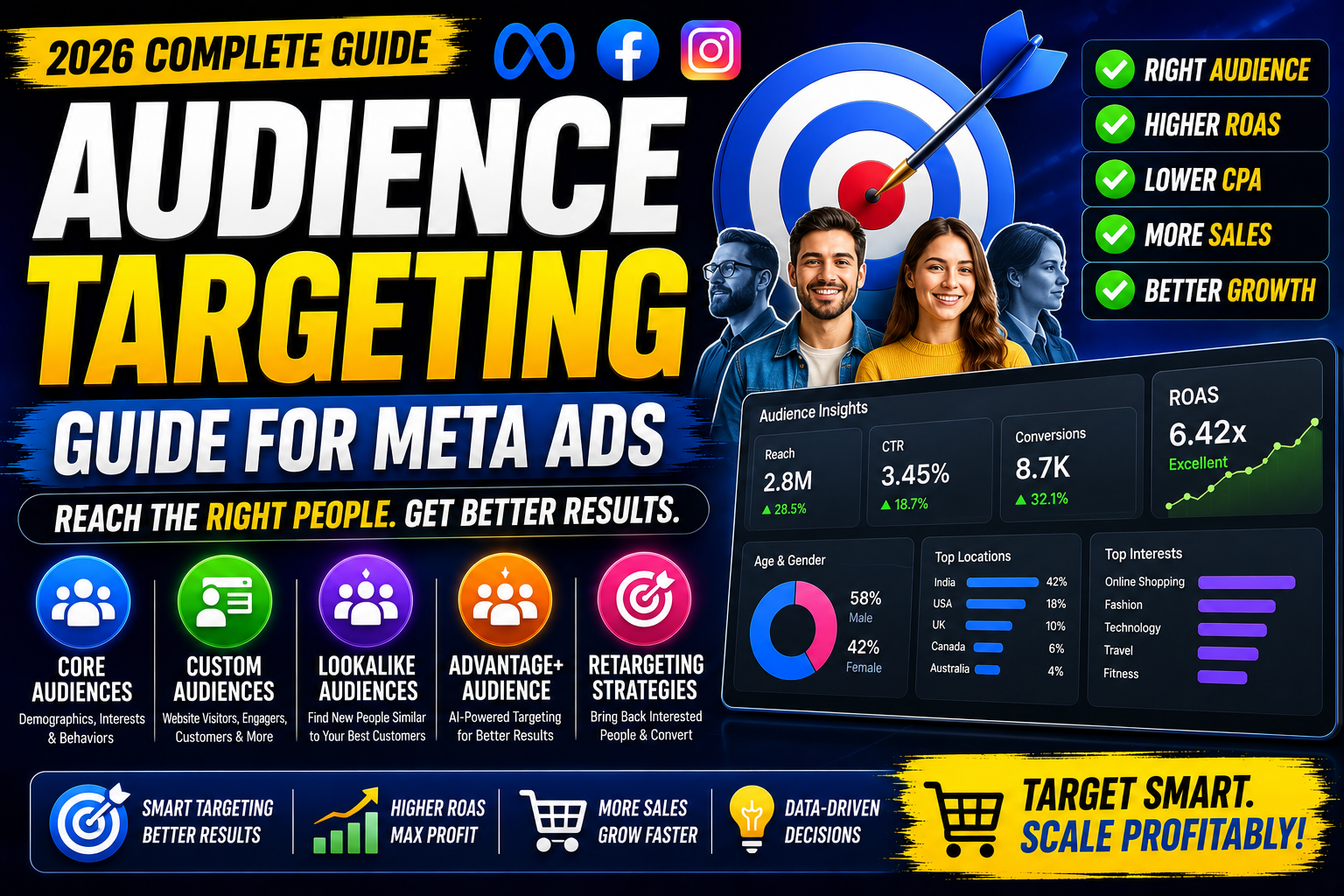
Audience Targeting Guide for Meta Ads (2026)
One of the biggest reasons Meta Ads fail isn't because of poor creatives or low budgets—it's because they're shown to the wrong audience.
Imagine trying to sell premium running shoes to people who have no interest in fitness. Even with the best ad design, the campaign is unlikely to perform well.
Audience targeting is the foundation of every successful Meta Ads campaign. It helps you connect with people who are most likely to engage with your brand, visit your website, and make a purchase.
In this complete guide, you'll learn how Meta's audience targeting works, the different audience types available, and proven strategies to improve your campaign performance.
What Is Audience Targeting?
Audience targeting is the process of selecting the people who will see your advertisements.
Instead of showing ads to everyone, Meta allows advertisers to define audiences using factors such as:
- Age
- Gender
- Location
- Language
- Interests
- Behaviors
- Purchase activity
- Website interactions
- Customer lists
The goal is to reach people who are most likely to complete your desired action.
Why Audience Targeting Matters
The right audience can significantly improve campaign performance.
Benefits include:
- Higher Click-Through Rate (CTR)
- Better Conversion Rate
- Lower Cost Per Click (CPC)
- Lower Cost Per Acquisition (CPA)
- Higher Return on Ad Spend (ROAS)
- Better customer quality
- Reduced wasted budget
How Meta Audience Targeting Works
Meta uses signals from user activity to help determine who may be interested in your ads.
Signals can include:
- Interests
- Online behavior
- Previous purchases
- App activity
- Website visits (when tracked)
- Content engagement
- Device usage
Campaign performance improves when Meta has sufficient conversion data to learn from.
Types of Meta Audiences
Meta provides four primary audience categories:
- Core Audiences
- Custom Audiences
- Lookalike Audiences
- Advantage+ Audience
Each serves a different purpose within the marketing funnel.
Core Audiences
Core Audiences are built using demographic and behavioral filters.
You can target users by:
Demographics
- Age
- Gender
- Relationship status
- Education
- Job title
Location
- Country
- State
- City
- Radius around a location
Language
Useful for multilingual campaigns.
Interests
Examples:
- Fitness
- Technology
- Fashion
- Travel
- Gaming
- Food
- Photography
- Finance
Behaviors
Examples:
- Online shoppers
- Frequent travelers
- Mobile device users
- Digital payment users
Core Audiences are ideal for reaching new potential customers.
Custom Audiences
Custom Audiences focus on people who have already interacted with your business.
Examples include:
- Website visitors
- Product page visitors
- Add-to-cart users
- Checkout initiators
- Existing customers
- Email subscribers
- Instagram profile visitors
- Facebook page followers
- Video viewers
- App users
These audiences are valuable because they already have some familiarity with your brand.
Lookalike Audiences
Lookalike Audiences help you discover new people who share characteristics with your existing customers.
You can create Lookalikes from:
- Purchasers
- Newsletter subscribers
- High-value customers
- Repeat buyers
- Website visitors
This strategy is often used to expand reach while maintaining relevance.
Advantage+ Audience
Advantage+ Audience uses Meta's AI to automatically expand targeting beyond your suggested audience when it predicts better results.
Benefits include:
- AI-powered audience discovery
- Less manual targeting
- Broader reach
- Continuous optimization
It is particularly useful for campaigns with sufficient conversion history.
Audience Segmentation Strategy
Organize audiences based on where users are in the customer journey.
Top of Funnel (Awareness)
Target:
- Broad interests
- Core Audiences
- Lookalike Audiences
Goal:
Introduce your brand.
Middle of Funnel (Consideration)
Target:
- Website visitors
- Video viewers
- Instagram engagers
- Facebook page followers
Goal:
Build trust and encourage product exploration.
Bottom of Funnel (Conversion)
Target:
- Add-to-cart users
- Checkout initiators
- Product viewers
Goal:
Drive purchases.
Loyalty Stage
Target:
- Existing customers
- Repeat buyers
Goal:
Increase repeat purchases and customer lifetime value.
Retargeting Strategy
Retarget users based on specific actions.
| Audience | Suggested Message |
|---|---|
| Product Viewers | "Still interested?" |
| Add-to-Cart Users | "Complete your purchase today." |
| Checkout Initiators | "Your order is waiting." |
| Existing Customers | "Recommended just for you." |
Retargeting often results in higher conversion rates because the audience has already shown intent.
Exclusion Audiences
Excluding certain users helps reduce wasted spend.
Examples:
- Recent purchasers
- Existing customers (when promoting acquisition offers)
- Employees
- Duplicate audience segments
Proper exclusions improve efficiency and user experience.
Audience Expansion
Once campaigns perform consistently, expand carefully by:
- Creating additional Lookalike Audiences.
- Testing broader interest groups.
- Adding nearby locations.
- Using Advantage+ Audience.
Expand gradually and monitor results closely.
Budget Allocation
Suggested approach:
Prospecting
Allocate a larger share of the budget to acquiring new customers.
Retargeting
Reserve a smaller portion for users who have already interacted with your business.
Adjust allocations based on performance and business objectives.
Audience Testing Framework
Test one variable at a time.
Examples:
- Interest A vs Interest B
- Lookalike Audience vs Core Audience
- Broad targeting vs Detailed targeting
Allow enough time for meaningful data before drawing conclusions.
Metrics to Monitor
Track audience performance using:
- CTR
- CPC
- CPM
- CPA
- ROAS
- Conversion Rate
- Frequency
- Reach
Compare metrics across audience segments to identify top performers.
Common Audience Targeting Mistakes
Avoid:
- Targeting audiences that are too broad or too narrow.
- Overlapping audience segments.
- Ignoring exclusions.
- Changing targeting too frequently.
- Making decisions before enough data is collected.
- Relying on assumptions instead of performance data.
Best Practices
- Define your ideal customer profile before launching campaigns.
- Use Core Audiences for prospecting.
- Retarget Custom Audiences.
- Expand with Lookalike Audiences.
- Test Advantage+ Audience where appropriate.
- Refresh audiences periodically.
- Exclude recent purchasers from acquisition campaigns.
- Base optimization decisions on data rather than guesswork.
Frequently Asked Questions
Which audience type is best for beginners?
Core Audiences are often a good starting point because they are simple to configure and help identify initial customer segments.
Are Lookalike Audiences effective?
They can be highly effective when built from high-quality source audiences such as purchasers or loyal customers.
What is Advantage+ Audience?
Advantage+ Audience uses Meta's AI to optimize audience delivery and expand beyond your initial suggestions when beneficial.
How often should I update audiences?
Review audience performance regularly and make changes only after sufficient data has been collected.
Should I exclude existing customers?
It depends on your campaign objective. Excluding existing customers is common for customer acquisition campaigns but may not be appropriate for upselling or repeat purchase campaigns.
Final Thoughts
Audience targeting is one of the most important factors in Meta Ads success. Even the most compelling creative cannot overcome poor targeting. By understanding Core Audiences, Custom Audiences, Lookalike Audiences, and Advantage+ Audience, you can deliver more relevant ads to the right people at the right stage of their buying journey.
Successful advertisers continuously test, analyze, and refine their audiences. Combine thoughtful segmentation with high-quality creatives, accurate tracking, and ongoing optimization to improve campaign efficiency, increase conversions, and maximize ROAS over the long term.