Topical Authority Explained 2026: Complete Guide to Building SEO Authority
Introduction
Ranking a single article on Google is becoming increasingly difficult due to growing competition and AI-powered search experiences. Instead of publishing isolated blog posts, successful websites build Topical Authority by covering an entire subject in depth.
Topical Authority helps search engines understand that your website is a trusted source on a specific topic. Rather than relying only on backlinks, websites with strong topical authority often rank higher because they consistently publish high-quality, interconnected content.
In this complete guide, you'll learn what Topical Authority is, why it matters, how Google evaluates it, and how to build it for long-term SEO success.
What is Topical Authority?
Topical Authority is the level of expertise and trust your website demonstrates by publishing comprehensive, high-quality content around a specific subject.
Instead of writing one article about SEO, a website with topical authority covers multiple related topics, such as:
What is SEO?
Keyword Research
On-Page SEO
Technical SEO
Off-Page SEO
Internal Linking
Google Search Console
Google Analytics 4
Rank Math
Core Web Vitals
Link Building
SEO Tools
Together, these articles signal to search engines that your website has deep knowledge of the subject.
Why is Topical Authority Important?
Benefits include:
✅ Higher Google Rankings
✅ Increased Organic Traffic
✅ Better Crawlability
✅ Stronger Internal Linking
✅ Improved User Experience
✅ More Featured Snippets
✅ Greater Trust & Credibility
✅ Long-Term SEO Growth
How Google Understands Topical Authority
Google evaluates topical authority using multiple signals, including:
Content depth
Relevance
Internal linking
Search intent satisfaction
Content freshness
User experience
Expertise and trustworthiness
No single metric determines topical authority—it's built over time through consistent, helpful content.
Topical Authority vs Domain Authority
| Feature | Topical Authority | Domain Authority |
|---|---|---|
| Focus | Expertise on a specific topic | Overall domain strength (third-party metric) |
| Based On | Content quality & topic coverage | Link profile & other signals |
| Controlled By | Your content strategy | Not a Google metric |
| SEO Value | High | Useful as a comparative metric |
Topical Authority is about becoming the best resource on a topic, while Domain Authority is a third-party estimate of a site's overall strength.
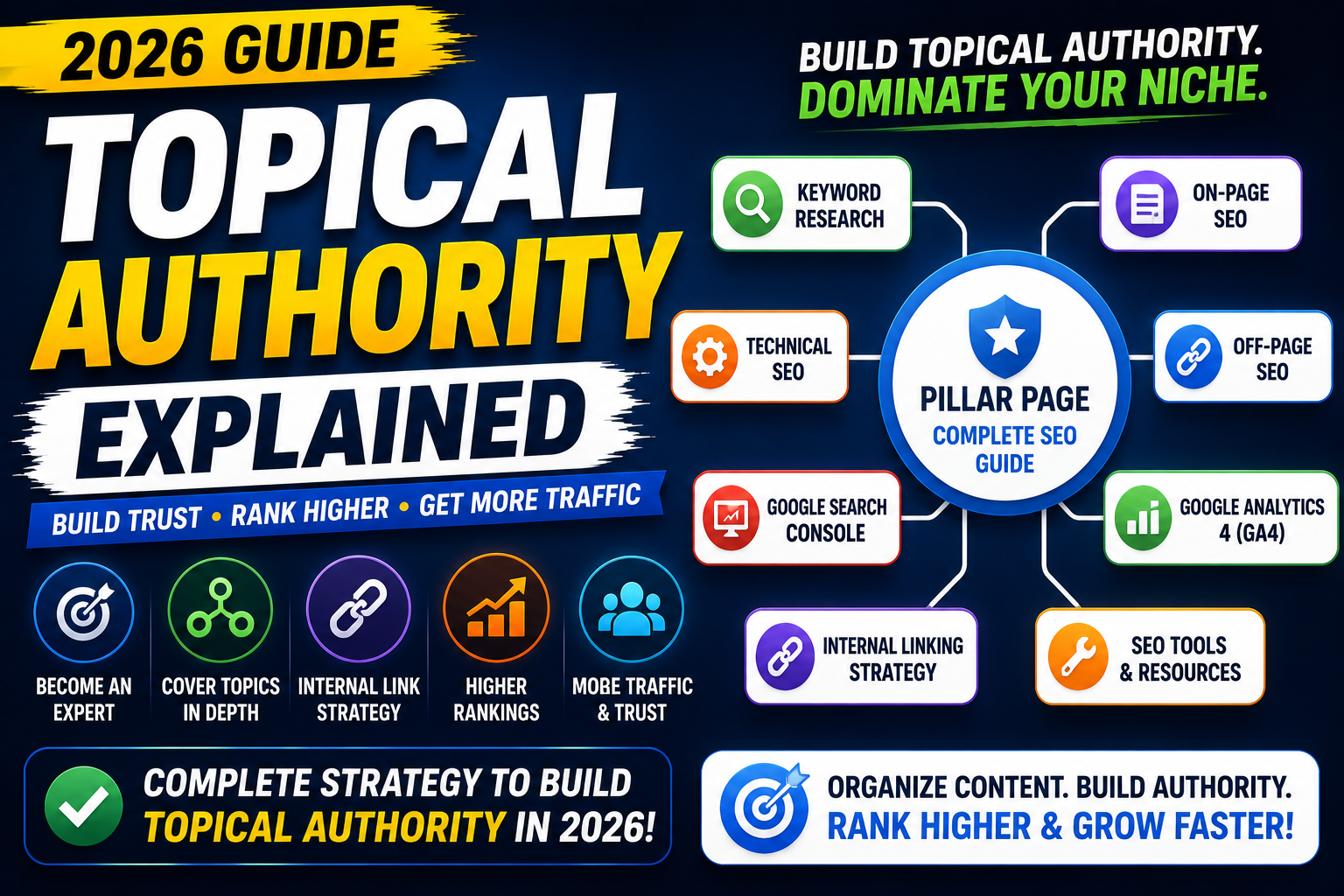
Pillar Pages
A pillar page is the main guide covering a broad topic.
Example:
Complete SEO Guide
↓
Links to:
What is SEO?
Keyword Research Guide
On-Page SEO
Technical SEO
Off-Page SEO
Internal Linking
Google Search Console
Google Analytics 4
Best SEO Tools
Rank Math Guide
The pillar page provides an overview, while supporting articles explore each topic in depth.
Topic Clusters
Topic clusters organize related content around one central subject.
Example:
SEO
↓
Keyword Research
↓
Technical SEO
↓
On-Page SEO
↓
Local SEO
↓
Link Building
↓
Core Web Vitals
↓
Structured Data
↓
Google Search Console
↓
Google Analytics
Each article links to related pages, creating a strong content network.
Internal Linking
Internal linking connects related articles together.
Example:
Keyword Research Guide
↓
On-Page SEO
↓
Technical SEO
↓
Internal Linking Strategy
↓
Topical Authority
Good internal linking helps search engines understand the relationships between your content.
Cover Every Search Intent
Create content for different user intents.
Informational
What is SEO?
Commercial
Best SEO Tools
Comparison
Ahrefs vs Semrush
Transactional
Best SEO Course
Meeting different search intents helps build comprehensive topical coverage.
Publish High-Quality Content
Focus on:
✔ Original insights
✔ Accurate information
✔ Practical examples
✔ Updated statistics
✔ Clear explanations
✔ Helpful visuals
Quality matters more than quantity.
Content Freshness
Regularly update:
Statistics
Screenshots
Tools
Best practices
Examples
Fresh content signals ongoing relevance.
Avoid Thin Content
Don't publish:
❌ Short, low-value articles
❌ Duplicate content
❌ AI-generated content without review
❌ Articles lacking practical information
Every page should provide meaningful value.
Build Supporting Articles
Example for an AI website:
Main Topic:
Artificial Intelligence
Supporting Articles:
What is AI?
AI Tools
AI for SEO
AI in Digital Marketing
AI for Business Automation
AI Workflow for Solopreneurs
AI Trends
AI Jobs
AI Myths vs Reality
Best AI Tools for Developers
Each supporting article strengthens the overall authority of the topic.
Topical Authority for Bloggers
Instead of writing random articles, organize your content into categories.
Example:
SEO
AI
Programming
Digital Marketing
Web Development
Cybersecurity
Cloud Computing
This creates a focused website structure.
Topical Authority for Businesses
A digital marketing agency could build authority around:
SEO
PPC
Social Media Marketing
Email Marketing
Content Marketing
Analytics
Conversion Optimization
Covering each area thoroughly demonstrates expertise.
Tools for Building Topical Authority
Useful tools include:
Google Search Console
Google Trends
Google Keyword Planner
Ahrefs
Semrush
Screaming Frog SEO Spider
Rank Math SEO
ChatGPT
Google Gemini
Claude AI
These tools help with keyword research, content planning, and performance analysis.
Common Mistakes
Avoid:
❌ Publishing unrelated topics
❌ Ignoring internal linking
❌ Writing duplicate content
❌ Not updating old articles
❌ Targeting only high-volume keywords
❌ Ignoring search intent
❌ Creating orphan pages
Best Practices
✔ Build pillar pages
✔ Create topic clusters
✔ Publish consistently
✔ Use strategic internal linking
✔ Update old content
✔ Cover beginner to advanced topics
✔ Answer common user questions
✔ Focus on quality over quantity
Decode With Jai Example
Your website could organize content like this:
SEO
What is SEO?
Complete SEO Guide
Keyword Research Guide
On-Page SEO Checklist
Technical SEO Checklist
Off-Page SEO Guide
Internal Linking Strategy
Topical Authority Explained
Google Search Console Guide
Google Analytics 4 Guide
Rank Math Guide
Best SEO Tools
AI
Best AI Tools
ChatGPT vs Claude
AI for SEO
AI in Digital Marketing
AI for Business Automation
AI Workflow
AI Trends
Future of AI Jobs
AI Myths vs Reality
This structure strengthens topical authority across your core subjects.
Final Thoughts
Topical Authority is one of the most effective long-term SEO strategies.
Rather than chasing individual keywords, focus on becoming the most trusted resource within your niche. Build comprehensive pillar pages, publish supporting content, connect everything with meaningful internal links, and update your content regularly.
Over time, this approach helps search engines better understand your expertise and can lead to stronger rankings, more organic traffic, and sustained growth.
Frequently Asked Questions (FAQs)
1. What is Topical Authority?
Topical Authority is the expertise a website demonstrates by publishing comprehensive, high-quality content around a specific subject.
2. Does Google use a Topical Authority score?
No. Google has not confirmed a specific "Topical Authority score." Instead, it evaluates many signals related to content quality, relevance, and usefulness.
3. How long does it take to build Topical Authority?
It depends on your niche, competition, and publishing consistency. Building strong topical authority typically takes months of consistent, high-quality work.
4. Are backlinks enough to build Topical Authority?
No. Backlinks help, but comprehensive content, internal linking, search intent coverage, and content quality are equally important.
5. What is the difference between a pillar page and a topic cluster?
A pillar page covers a broad topic, while topic clusters are supporting articles that explore related subtopics in greater detail.
6. Can a new website build Topical Authority?
Yes. New websites can establish topical authority by focusing on one niche, creating comprehensive content clusters, and consistently publishing valuable, well-linked articles.