How Google Ranking Works 2026: Complete Guide to How Google Ranks Websites
Every website owner wants to know the same thing:
"How does Google decide which website ranks #1?"
The answer isn't a single ranking factor or secret algorithm. Google uses hundreds of signals to determine which pages are the most relevant, helpful, and trustworthy for a user's search query.
Whether you're a blogger, SEO professional, business owner, developer, or digital marketer, understanding how Google ranking works will help you create better content, improve user experience, and increase organic traffic.
In this complete guide, you'll learn how Google's search system works, what influences rankings, and the best practices to improve your visibility in 2026.
What is Google Ranking?
Google Ranking refers to the position of your webpage in Google's search results for a specific keyword or query.
Example:
Keyword:
Best SEO Tools
Google may display:
Website A
Website B
Website C
Website D
The goal of SEO is to improve your website's visibility for relevant searches.
Does Google Use One Ranking Factor?
No.
Google has stated that its search systems use many signals and systems to rank content. There isn't one factor that guarantees a #1 ranking.
Some important areas include:
Content relevance
Search intent
Page quality
User experience
Links
Page speed
Mobile usability
Freshness (for queries where it matters)
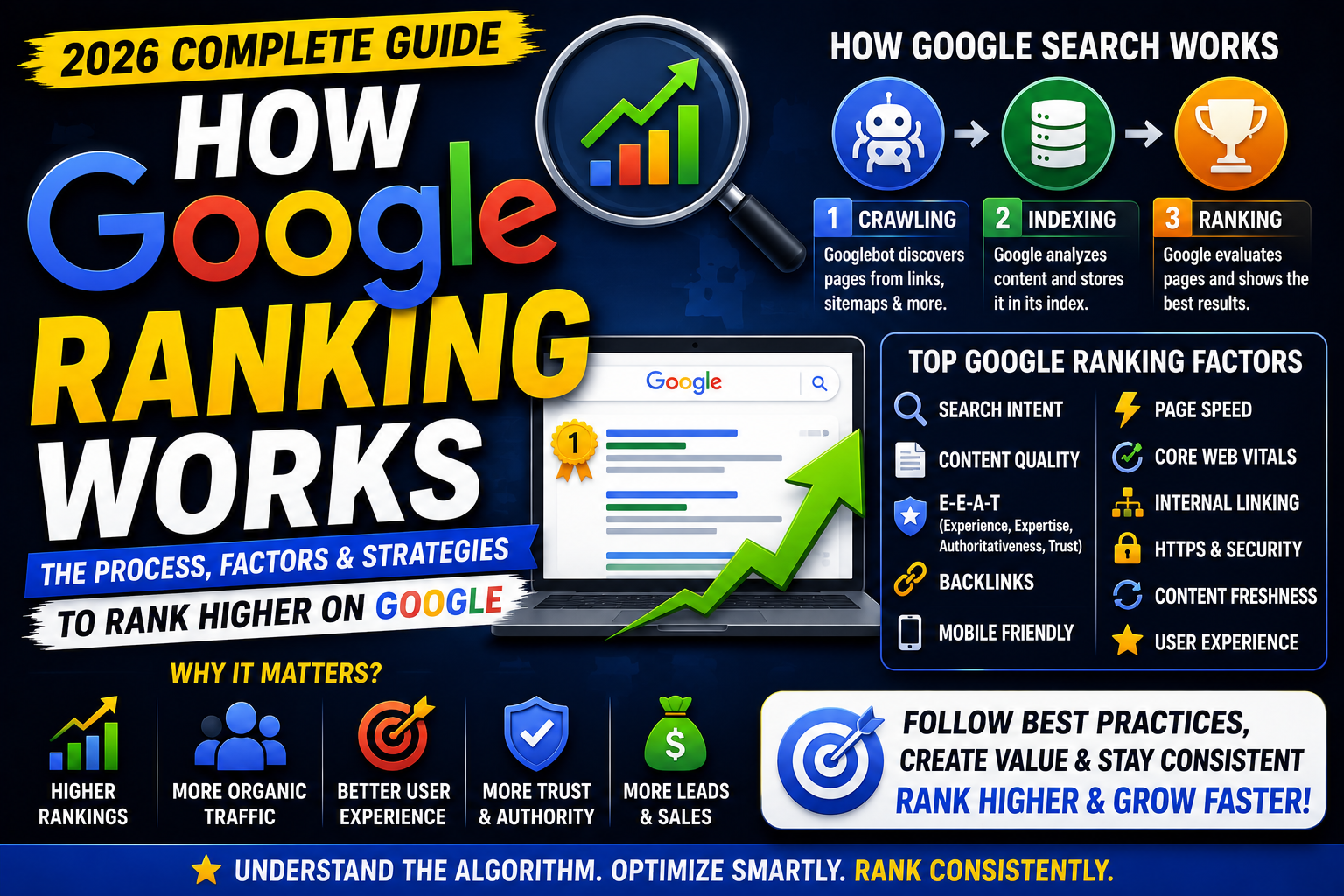
How Google Search Works
Google Search generally follows these stages:
1. Crawling
Googlebot discovers pages by following links and reading XML sitemaps.
If a page can't be crawled, it can't be considered for ranking.
2. Indexing
After crawling, Google analyzes the content.
If the page meets Google's quality requirements, it may be added to the search index.
Not every crawled page gets indexed.
3. Ranking
When someone searches,
Google evaluates indexed pages and orders results based on many relevance and quality signals.
Understanding Search Intent
One of the biggest ranking factors is search intent.
Google wants to show results that best satisfy what the user is trying to accomplish.
Common intent types:
Informational
"What is SEO?"
Navigational
"Google Search Console"
Commercial Investigation
"Best SEO Tools"
Transactional
"Buy Laptop Online"
Creating content that matches the intent behind the query is essential.
Content Quality
Google rewards content that is:
✅ Helpful
✅ Accurate
✅ Original
✅ Comprehensive
✅ Well-structured
Avoid:
❌ Thin content
❌ Duplicate content
❌ Misleading information
❌ Keyword stuffing
E-E-A-T
Google encourages content that demonstrates:
Experience
Expertise
Authoritativeness
Trust
Trust is especially important for topics involving health, finance, or safety.
Topical Authority
Publishing one article isn't enough.
Example:
SEO Website
↓
What is SEO
↓
Keyword Research
↓
Technical SEO
↓
On-Page SEO
↓
Off-Page SEO
↓
Internal Linking
↓
Google Search Console
↓
Google Analytics
↓
Rank Math
↓
Best SEO Tools
Comprehensive topic coverage helps establish expertise.
Internal Linking
Internal links help Google:
Discover pages
Understand website structure
Identify important pages
They also improve user navigation.
Backlinks
Backlinks are links from other websites pointing to your content.
Quality backlinks from reputable websites can strengthen your site's authority.
Focus on earning links naturally through valuable content rather than trying to manipulate rankings.
Page Experience
Google also considers aspects of user experience, including:
Mobile friendliness
HTTPS security
Fast loading pages
Stable layouts
A positive page experience supports users and complements quality content.
Core Web Vitals
Important metrics include:
Largest Contentful Paint (LCP)
Target:
Under 2.5 seconds
Interaction to Next Paint (INP)
Target:
Under 200 ms
Cumulative Layout Shift (CLS)
Target:
Below 0.1
Improving these metrics can enhance usability.
Mobile-First Indexing
Google primarily uses the mobile version of your website for indexing and ranking.
Ensure your website is:
✔ Responsive
✔ Fast
✔ Easy to navigate
Crawlability
Google must be able to access your pages.
Best practices:
Submit XML Sitemap
Use clean URLs
Fix broken links
Avoid blocking important pages with robots.txt
Indexability
Reasons a page may not be indexed:
Noindex tag
Duplicate content
Poor quality
Blocked resources
Crawl issues
Use Google Search Console to investigate indexing problems.
Structured Data (Schema)
Structured data helps search engines better understand your content.
Common schema types:
Article
FAQ
Breadcrumb
Product
Organization
Local Business
Video
Schema may improve eligibility for rich results.
Fresh Content
Some queries benefit from recently updated information.
Update:
Statistics
Examples
Screenshots
AI tools
SEO techniques
Regular updates keep content useful.
Keyword Optimization
Use keywords naturally in:
Title
URL
H1 Heading
Subheadings
Introduction
Image ALT Text
Meta Description
Write for readers first—not search engines.
User Experience (UX)
Good UX includes:
✔ Easy navigation
✔ Clear headings
✔ Readable fonts
✔ Mobile responsiveness
✔ Helpful images
✔ Logical page structure
Happy users are more likely to engage with your content.
Website Authority
Authority grows through:
Helpful content
Positive brand reputation
Quality backlinks
Topical expertise
Consistent publishing
Authority develops over time.
AI & Google Search
Google focuses on the quality of content, not whether AI assisted in creating it.
AI can help with:
Research
Outlines
Brainstorming
Editing
However, content should be reviewed, fact-checked, and enriched with human insight and original value.
Google Ranking Myths
Avoid believing:
❌ More keywords = higher rankings
❌ More pages = better SEO
❌ Buying backlinks guarantees success
❌ AI content automatically ranks
❌ Exact-match domains guarantee rankings
❌ Meta keywords influence rankings
Best Practices to Improve Rankings
✔ Create people-first content
✔ Match search intent
✔ Build topical authority
✔ Improve internal linking
✔ Optimize page speed
✔ Use HTTPS
✔ Make your website mobile-friendly
✔ Earn quality backlinks
✔ Keep content updated
✔ Monitor performance with Google Search Console
Tools to Improve Rankings
Useful tools:
Google Search Console
Google Analytics 4
Google Trends
Google Keyword Planner
PageSpeed Insights
Lighthouse
Rank Math SEO
Ahrefs
Semrush
Screaming Frog SEO Spider
Common SEO Mistakes
Avoid:
❌ Keyword stuffing
❌ Thin content
❌ Duplicate content
❌ Slow websites
❌ Poor mobile experience
❌ Broken internal links
❌ Ignoring Search Console
❌ Publishing without a content strategy
Final Thoughts
Google's ranking systems are designed to connect users with the most relevant and helpful information—not simply the pages that use the most keywords.
Instead of chasing shortcuts, focus on publishing valuable content, understanding search intent, improving technical SEO, creating a great user experience, and building topical authority.
Consistent improvements across these areas give your website the best chance of earning sustainable organic traffic.
Frequently Asked Questions (FAQs)
1. How does Google rank websites?
Google ranks websites by evaluating many signals, including content relevance, search intent, page quality, usability, links, and technical factors.
2. Is there one Google ranking factor?
No. Google uses many signals and systems to rank content. There is no single factor that guarantees top rankings.
3. Are backlinks still important?
Yes. High-quality backlinks remain an important signal, but they're only one part of a successful SEO strategy.
4. Does page speed affect rankings?
Page speed contributes to page experience and user satisfaction. While it's important, content quality and relevance are typically more influential.
5. Can AI-generated content rank on Google?
Yes, if it is original, accurate, helpful, and provides value to users. The focus is on content quality rather than the method used to create it.
6. How long does it take to rank on Google?
It varies depending on competition, content quality, website authority, and technical SEO. Some pages may rank within weeks, while competitive topics can take months or longer.