Google Ads Quality Score Guide (2026): Improve Quality Score & Lower Your CPC
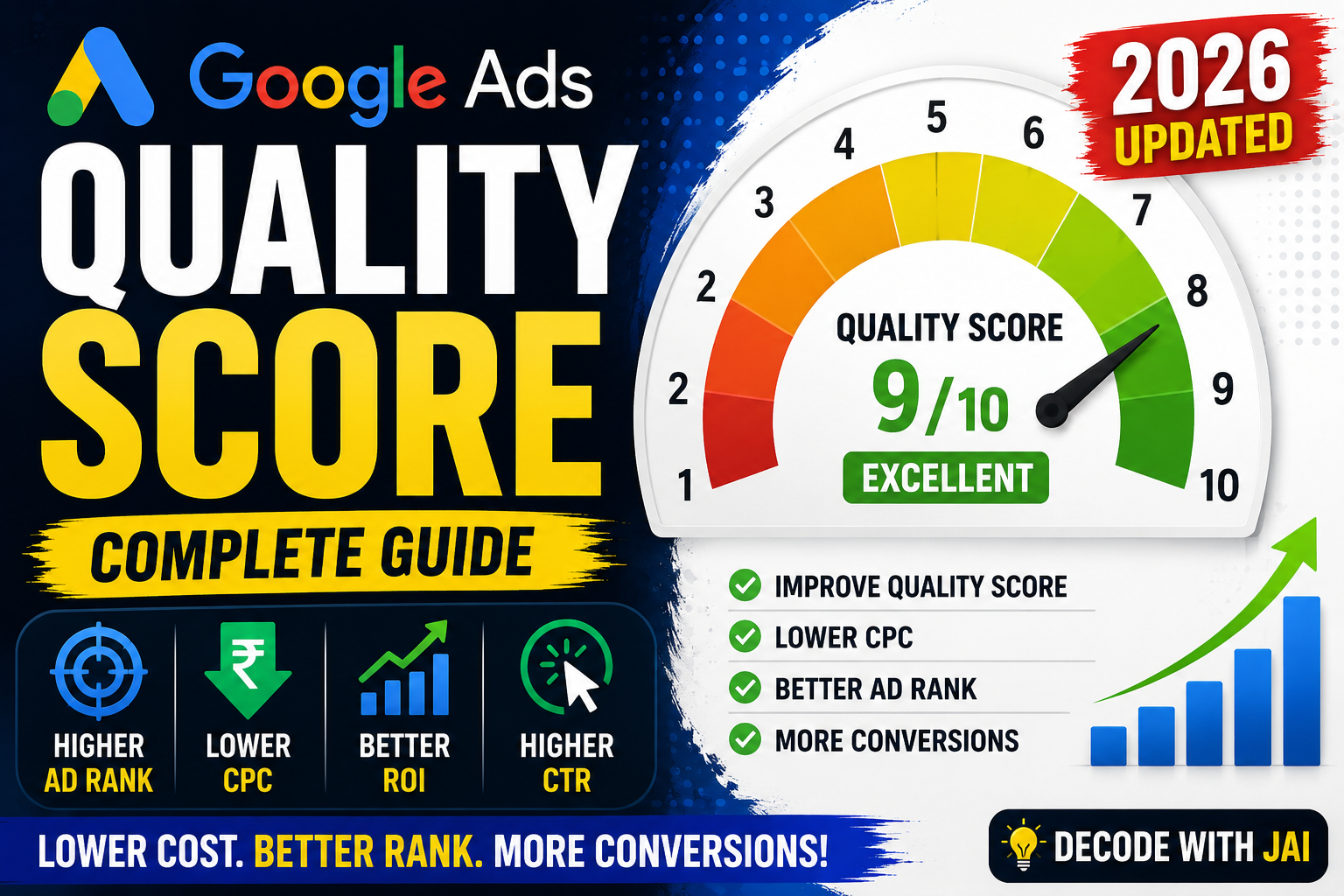
Google Ads is one of the most powerful advertising platforms, but simply bidding higher doesn't guarantee success. One of the most important factors that determines your campaign's performance is Quality Score.
Quality Score influences where your ads appear, how much you pay per click (CPC), and how competitive your campaigns can be. A higher Quality Score often means lower advertising costs, better ad positions, and improved return on investment (ROI).
In this complete Google Ads Quality Score Guide for 2026, you'll learn what Quality Score is, why it matters, how Google calculates it, and practical strategies to improve it. Whether you're a beginner or an experienced marketer, this guide will help you optimize your campaigns for better performance.
Table of Contents
- What is Google Ads Quality Score?
- Why Quality Score Matters
- How Google Calculates Quality Score
- The Three Components of Quality Score
- Quality Score Ratings Explained
- Where to Find Quality Score
- Quality Score vs Ad Rank
- How Quality Score Affects CPC
- Factors That Improve Quality Score
- Common Mistakes That Lower Quality Score
- How to Improve Quality Score
- Quality Score Best Practices
- Quality Score Checklist
- Frequently Asked Questions
- Final Thoughts
What is Google Ads Quality Score?
Quality Score is Google's rating of the relevance and quality of your keywords, ads, and landing pages. It helps Google determine how useful your ads are for users searching for specific keywords.
Quality Score is measured on a scale of 1 to 10, where:
- 1–3: Poor
- 4–6: Average
- 7–8: Good
- 9–10: Excellent
A higher Quality Score indicates that your ad and landing page provide a better user experience.
Why Quality Score Matters
A good Quality Score can:
- Lower your Cost Per Click (CPC)
- Improve your Ad Rank
- Increase ad visibility
- Improve Click-Through Rate (CTR)
- Boost conversions
- Maximize return on ad spend (ROAS)
Businesses with higher Quality Scores often achieve better results without increasing their budgets.
How Google Calculates Quality Score
Google evaluates several signals to estimate the quality and relevance of your ads. While the exact algorithm isn't public, the main components are:
1. Expected Click-Through Rate (CTR)
Google estimates how likely users are to click your ad based on historical performance and relevance.
2. Ad Relevance
This measures how closely your ad matches the intent behind the user's search query.
3. Landing Page Experience
Google evaluates whether your landing page provides a useful, fast, and relevant experience for visitors.
The Three Components of Quality Score
Expected CTR
A higher CTR signals that users find your ad useful and relevant.
Ways to improve:
- Write compelling headlines
- Include the primary keyword
- Use strong calls to action
- Test multiple ad variations
Ad Relevance
Ensure your keywords, ad copy, and landing page are closely aligned.
Example:
If your keyword is "Google Ads Course", your ad and landing page should focus on Google Ads courses—not general digital marketing.
Landing Page Experience
Google values pages that:
- Load quickly
- Are mobile-friendly
- Match the ad message
- Provide helpful content
- Have clear navigation
Quality Score Ratings Explained
| Quality Score | Meaning | Recommendation |
|---|---|---|
| 1–3 | Poor | Review keywords, ads, and landing pages |
| 4–6 | Average | Optimize relevance and user experience |
| 7–8 | Good | Continue testing and refining |
| 9–10 | Excellent | Maintain performance and scale campaigns |
Where to Find Quality Score
In Google Ads:
- Open your account.
- Go to Campaigns.
- Select Keywords.
- Customize columns.
- Add Quality Score and its component metrics.
Monitoring Quality Score regularly helps identify underperforming keywords.
Quality Score vs Ad Rank
Many advertisers confuse Quality Score with Ad Rank, but they are different.
| Quality Score | Ad Rank |
|---|---|
| Measures keyword quality | Determines ad position |
| Scale of 1–10 | Dynamic auction metric |
| Based on relevance | Based on bid, Quality Score, and auction signals |
A high Quality Score can improve Ad Rank even if your bid isn't the highest.
How Quality Score Affects CPC
Higher Quality Scores generally reduce the amount you pay for each click.
For example:
- Advertiser A: High bid, low Quality Score
- Advertiser B: Moderate bid, high Quality Score
Advertiser B may achieve a better ad position while paying less per click because Google rewards relevance.
Factors That Improve Quality Score
Focus on:
- Highly relevant keywords
- Well-structured ad groups
- Compelling ad copy
- Fast-loading landing pages
- Mobile optimization
- Clear calls to action
- Strong historical CTR
- Positive user experience
Common Mistakes That Lower Quality Score
Avoid these issues:
- Using unrelated keywords
- Generic ad copy
- Slow landing pages
- Sending traffic to the homepage instead of a relevant page
- Ignoring mobile users
- Poor keyword organization
- Low CTR
- Lack of negative keywords
How to Improve Quality Score
- Group similar keywords into tightly themed ad groups.
- Include target keywords in headlines and descriptions.
- Improve landing page speed.
- Match landing page content with the ad.
- Add relevant ad assets.
- Remove low-performing keywords.
- Use negative keywords to filter irrelevant traffic.
- Continuously A/B test your ads.
Best Practices for 2026
- Focus on search intent rather than keyword stuffing.
- Build landing pages for specific campaigns.
- Use responsive search ads effectively.
- Optimize for mobile-first experiences.
- Monitor search term reports weekly.
- Improve Core Web Vitals.
- Keep ad copy aligned with landing page content.
Quality Score Optimization Checklist
✅ Target relevant keywords
✅ Organize focused ad groups
✅ Write compelling ad copy
✅ Improve expected CTR
✅ Enhance landing page speed
✅ Optimize for mobile
✅ Match landing pages to keywords
✅ Add negative keywords
✅ Monitor Quality Score regularly
✅ Test and refine campaigns continuously
Frequently Asked Questions
What is a good Quality Score in Google Ads?
A score of 7 or higher is generally considered good, while 9–10 is excellent.
Does Quality Score affect CPC?
Yes. Higher Quality Scores often lead to lower Cost Per Click and better ad positions.
How often does Quality Score update?
Quality Score is updated based on ongoing performance and available data, so it can change over time.
Can I improve Quality Score quickly?
Some improvements, such as better ad relevance or landing page changes, can have an impact relatively quickly, while others depend on accumulating performance data.
Does Quality Score affect SEO?
No. Quality Score is used only within Google Ads and has no direct impact on organic search rankings.
Final Thoughts
Quality Score is one of the most influential metrics in Google Ads. Instead of increasing bids to compete, focus on improving the relevance of your keywords, ads, and landing pages.
By optimizing expected CTR, ad relevance, and landing page experience, you can lower costs, improve ad visibility, and drive more valuable traffic to your website. Treat Quality Score as an ongoing optimization process rather than a one-time task, and you'll build stronger, more profitable campaigns over time.