E-E-A-T in SEO 2026: Complete Guide to Experience, Expertise, Authoritativeness & Trust
Introduction
If you've been learning SEO, you've probably come across the term E-E-A-T. It's one of the most important concepts in modern SEO and content creation.
While E-E-A-T is not a direct Google ranking factor, it represents qualities Google encourages its human quality raters to look for when evaluating search results. Content that demonstrates strong Experience, Expertise, Authoritativeness, and Trust is more likely to satisfy users and align with Google's guidance on creating helpful content.
Whether you're a blogger, business owner, freelancer, affiliate marketer, or digital marketer, understanding E-E-A-T can help you build a trustworthy website that users and search engines value.
In this complete guide, you'll learn everything about E-E-A-T, why it matters, and how to apply it to improve your website.
What is E-E-A-T?
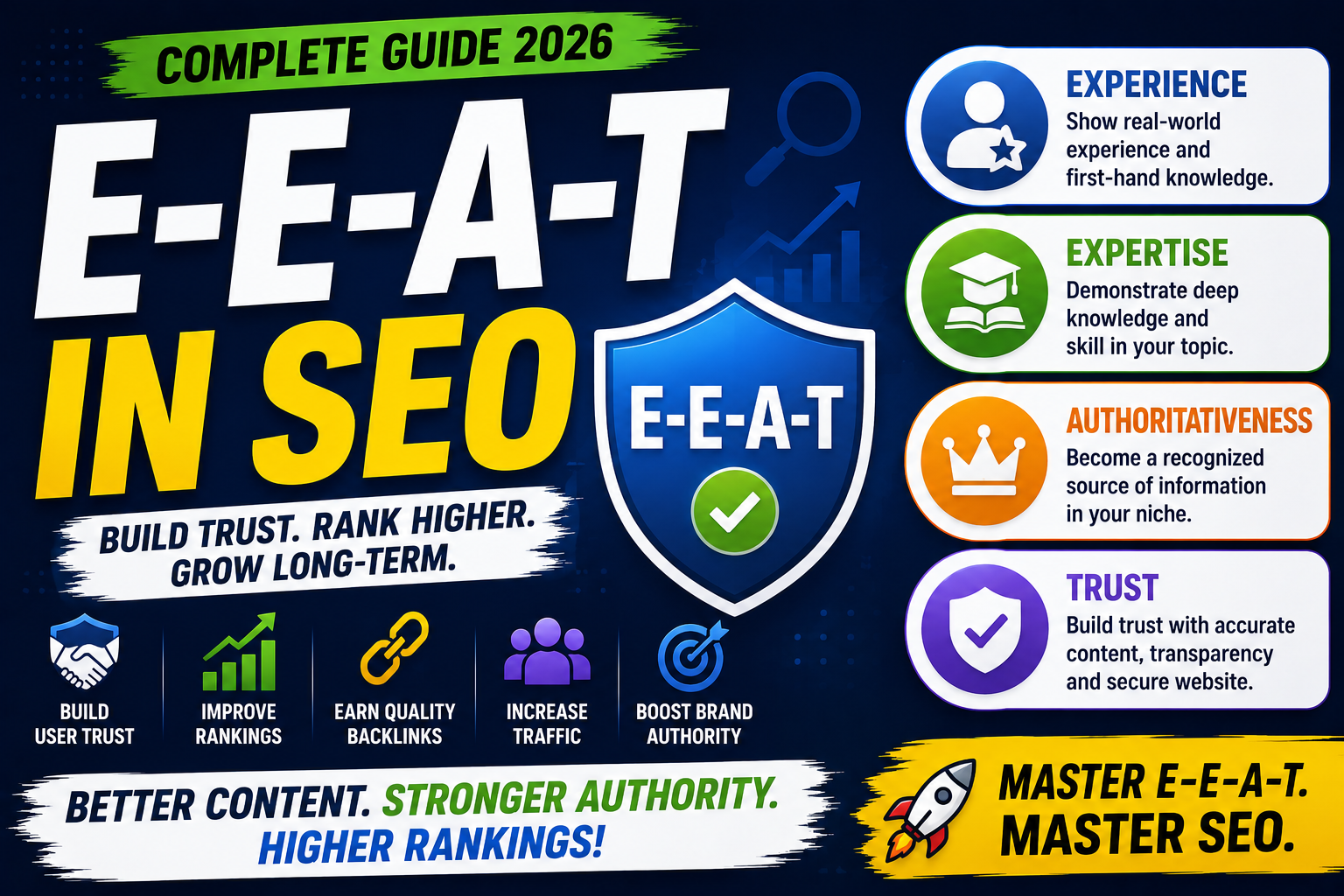
E-E-A-T stands for:
Experience
Expertise
Authoritativeness
Trust
These concepts are described in Google's Search Quality Rater Guidelines, which are used by human evaluators to assess search quality—not to directly rank websites.
Why is E-E-A-T Important?
Benefits include:
✅ Build User Trust
✅ Improve Content Quality
✅ Increase Brand Credibility
✅ Support Long-Term SEO
✅ Improve Conversion Rates
✅ Strengthen Reputation
✅ Encourage High-Quality Backlinks
The Four Pillars of E-E-A-T
1. Experience
Experience means showing first-hand knowledge of a topic.
Examples:
Personal case studies
Real product usage
Original screenshots
Testing results
Step-by-step tutorials
Practical examples
Instead of repeating information from other websites, demonstrate that you've actually done what you're writing about.
2. Expertise
Expertise refers to knowledge and skill in a subject.
Examples:
In-depth tutorials
Technical explanations
Accurate information
Industry knowledge
Educational content
For example, a web developer writing about HTML or SEO can demonstrate expertise through clear explanations and practical guidance.
3. Authoritativeness
Authority develops when others recognize your website or brand as a reliable resource.
Authority can grow through:
High-quality content
Industry recognition
Positive mentions
Quality backlinks
Speaking engagements
Original research
Helpful resources
Authority is built over time through consistent work.
4. Trust
Google describes Trust as the most important element of E-E-A-T.
Ways to build trust:
✔ HTTPS
✔ Accurate information
✔ Clear contact details
✔ Privacy Policy
✔ Terms & Conditions
✔ Author information
✔ Secure website
✔ Updated content
✔ Honest reviews
✔ Transparent disclosures
E-E-A-T vs SEO
| E-E-A-T | Traditional SEO |
|---|---|
| Focuses on content quality and trust | Focuses on optimization techniques |
| Encourages user-first content | Includes technical improvements |
| Builds long-term credibility | Improves discoverability |
| Supports sustainable growth | Supports rankings |
The best SEO strategy combines technical SEO with high-quality, trustworthy content.
Why Experience Was Added
Google added Experience to emphasize the value of first-hand knowledge.
Examples:
❌ Writing about a product you've never used.
✅ Reviewing a product after testing it.
❌ Giving SEO advice without practical experience.
✅ Sharing SEO results from your own website.
Readers value authentic experiences.
How to Improve E-E-A-T
Create Helpful Content
Write for users first.
Answer:
What?
Why?
How?
When?
Who?
Focus on solving problems rather than just targeting keywords.
Add Author Information
Include:
Author Name
Bio
Experience
Skills
Social Profiles (optional)
Website (optional)
This helps readers understand who created the content.
Keep Content Updated
Regularly update:
Statistics
Screenshots
Examples
SEO techniques
AI tools
Best practices
Fresh content is more useful to readers.
Add Original Images
Instead of relying only on stock images:
Use:
Screenshots
Infographics
Charts
Original diagrams
Photos you've taken (where appropriate)
Original visuals strengthen credibility.
Cite Reliable Sources
Reference authoritative sources when discussing facts or research.
Examples include:
Official documentation
Government websites
Academic research
Industry publications
Avoid spreading unverified claims.
Build a Strong About Page
Your About page should explain:
Who you are
What your website covers
Why readers should trust you
Your mission
Improve Website Trust
Include:
HTTPS
Contact Page
Privacy Policy
Terms & Conditions
Disclaimer
Cookie Policy (if applicable)
These pages contribute to a professional user experience.
E-E-A-T for Different Websites
Blogs
Publish:
Helpful tutorials
Real examples
Updated guides
FAQs
Business Websites
Include:
Company information
Team details
Customer testimonials
Contact information
eCommerce Websites
Show:
Product reviews
Shipping policies
Return policy
Secure payment methods
Portfolio Websites
Include:
Projects
Skills
Experience
Client testimonials
YMYL (Your Money or Your Life)
Google applies especially high quality standards to topics that can affect people's:
Health
Finances
Safety
Legal decisions
Examples:
Medical advice
Investment guidance
Legal information
Insurance
Banking
For these topics, demonstrating strong E-E-A-T is especially important.
Common E-E-A-T Mistakes
Avoid:
❌ Publishing copied content
❌ Making unsupported claims
❌ Using misleading titles
❌ Anonymous content without author details
❌ Outdated information
❌ Poor website security
❌ Thin content
❌ Overusing AI without human review
AI and E-E-A-T
AI can help with:
Research
Outlines
Grammar
Brainstorming
Draft generation
However, AI should not replace:
Personal experience
Expert review
Fact-checking
Original insights
The strongest content combines AI assistance with human expertise.
Best Practices
✔ Write original content
✔ Share real experience
✔ Add author bios
✔ Update articles regularly
✔ Build topical authority
✔ Use internal linking
✔ Cite trustworthy sources
✔ Improve website security
✔ Focus on user intent
✔ Be transparent
E-E-A-T Checklist
Before publishing, ask:
✅ Is the information accurate?
✅ Have I demonstrated first-hand experience where relevant?
✅ Is the article comprehensive?
✅ Have I added author details?
✅ Are all claims supported?
✅ Is the content updated?
✅ Does the page build trust?
Final Thoughts
E-E-A-T isn't a checklist that guarantees higher rankings—it's a framework for creating content that users can trust.
By combining real-world experience, subject expertise, authoritative resources, transparent authorship, and strong technical SEO, you can build a website that delivers lasting value.
Instead of focusing only on search engines, focus on becoming the best resource for your audience. That's the foundation of sustainable SEO success.
Frequently Asked Questions (FAQs)
1. What does E-E-A-T stand for?
E-E-A-T stands for Experience, Expertise, Authoritativeness, and Trust.
2. Is E-E-A-T a Google ranking factor?
Google has stated that E-E-A-T itself is not a direct ranking factor. It is a framework used in the Search Quality Rater Guidelines to evaluate the quality and trustworthiness of content.
3. Why is Trust the most important part of E-E-A-T?
According to Google's Search Quality Rater Guidelines, Trust is the most important component because users need confidence that the information they're reading is accurate, safe, and reliable.
4. How can I improve E-E-A-T on my website?
You can improve E-E-A-T by publishing original content, demonstrating first-hand experience, providing author information, citing reliable sources, maintaining accurate content, and ensuring your website is secure and transparent.
5. Does AI-generated content violate E-E-A-T?
No. Google focuses on the quality and usefulness of content, not how it was created. AI-generated content should be reviewed, fact-checked, and enhanced with human expertise and original insights.
6. Which websites benefit the most from E-E-A-T?
Every website benefits, but it's especially important for YMYL (Your Money or Your Life) topics such as health, finance, legal advice, insurance, and medical content.