AI and SEO 2026: How Artificial Intelligence Is Changing Search Engine Optimization
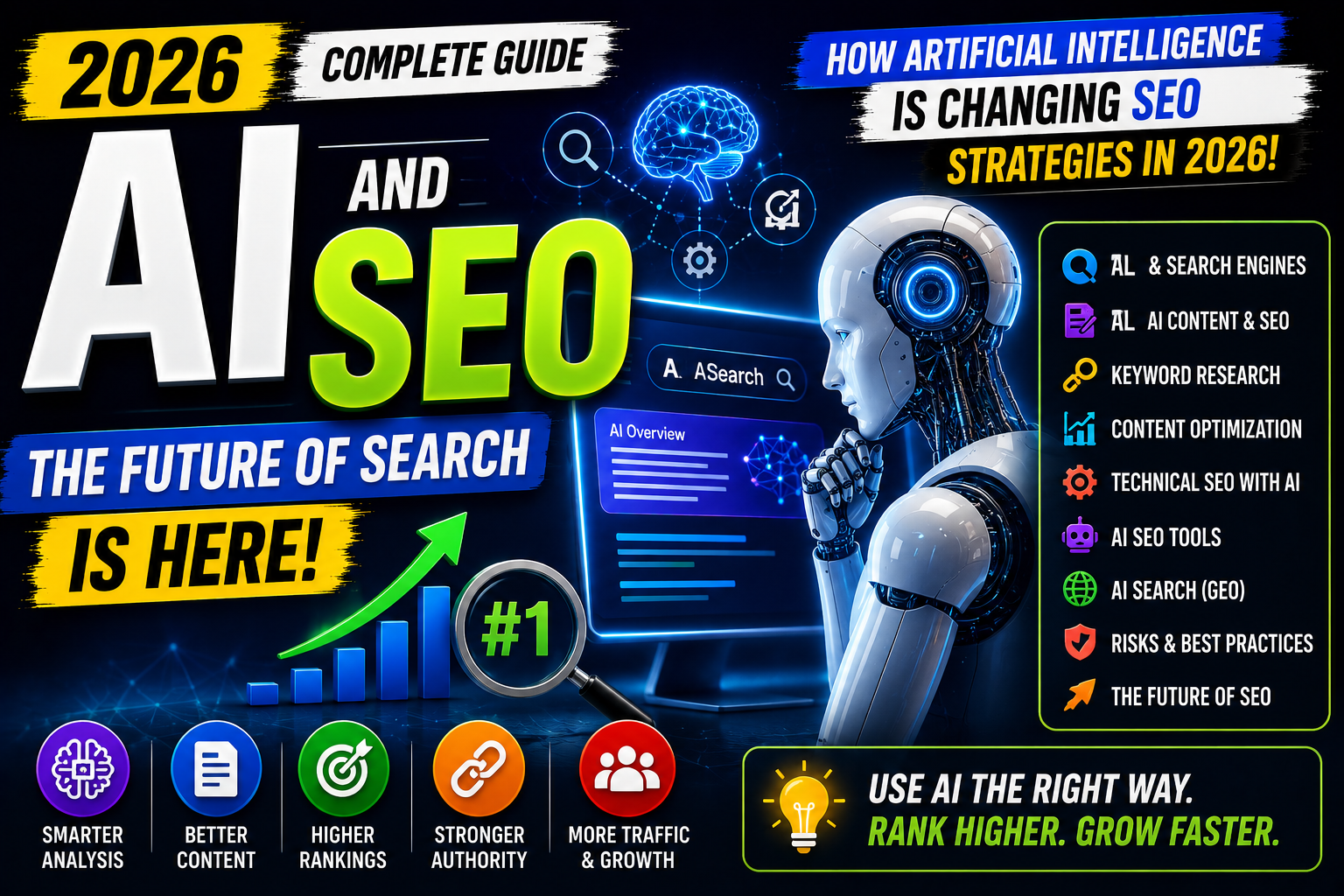
Artificial Intelligence is changing how people search, create content, analyze data, and discover information online.
At the same time, Search Engine Optimization is evolving.
SEO is no longer only about adding keywords to a page, building backlinks, and trying to reach the first position on Google.
Search engines are becoming more intelligent. AI-powered search experiences can summarize information, understand complex queries, interpret search intent, and present answers directly to users.
Marketers and website owners are also using AI for keyword research, content planning, technical SEO, data analysis, image optimization, and workflow automation.
This creates an important question:
Is AI replacing SEO, or is AI making SEO more advanced?
The answer is more complex than choosing one side.
In this complete AI and SEO guide, you'll learn how artificial intelligence is changing SEO, how AI can support search optimization, the risks of AI-generated content, how AI search affects website traffic, and what SEO professionals should focus on in 2026.
What Is AI in SEO?
AI in SEO refers to using artificial intelligence technologies to support search engine optimization tasks.
AI can help with:
Keyword research
Search intent analysis
Content planning
Topic clustering
Content optimization
Technical SEO analysis
Internal linking
Competitor research
Data analysis
SEO automation
AI does not automatically perform successful SEO.
It processes information, identifies patterns, and helps SEO professionals work more efficiently.
The final strategy still requires human judgment.
How AI Is Changing SEO
Traditional SEO workflows often involve manually analyzing large amounts of information.
For example, an SEO professional may review:
Hundreds of keywords
Competitor pages
Search Console queries
Internal links
Technical errors
Content gaps
AI can process large datasets and identify patterns faster.
This allows marketers to spend more time on:
Strategy
Content quality
User experience
Original research
Brand building
AI is changing SEO from a completely manual process into a more data-assisted workflow.
How Search Engines Use AI
Modern search engines use machine learning and AI systems to better understand queries and webpages.
AI can help search systems understand:
Search intent
Natural language
Context
Relationships between concepts
Content relevance
User queries
For example, two users may search:
best laptop for programming
and:
which computer should I buy for coding
The wording is different.
The intent is similar.
Modern search systems are increasingly capable of understanding this relationship.
This means SEO should focus on topics and user needs—not only exact keyword repetition.
AI Search Is Changing User Behavior
Users are increasingly asking longer and more conversational questions.
Traditional search:
best seo tools
Conversational search:
What are the best SEO tools for a beginner running a small Blogger website?
The second query contains more context.
AI-powered search systems can interpret these detailed questions and generate more direct answers.
For content creators, this means articles should answer real questions clearly and comprehensively.
What Is Generative Engine Optimization?
Generative Engine Optimization, commonly called GEO, is an emerging term used to describe strategies aimed at improving content visibility within AI-generated search experiences.
Traditional SEO focuses heavily on search engine result pages.
GEO discussions focus on visibility in AI-generated answers.
The goal may include helping AI systems:
Understand your content
Identify useful information
Recognize entities
Find clear facts
Connect topics
Reference authoritative sources
GEO should not be treated as a guaranteed method for appearing in AI answers.
AI platforms use different systems and may change how sources are selected.
However, clear and trustworthy content can improve how easily information is understood.
SEO vs GEO
| Feature | SEO | GEO |
|---|---|---|
| Main Focus | Search Results | AI-Generated Answers |
| Target | Search Engines | Generative Search Systems |
| Content Goal | Rank and Earn Clicks | Improve Understanding and Visibility |
| Keywords | Important | Context and Entities Important |
| Backlinks | Important | Authority Signals Can Matter |
| Structure | SEO-Friendly | Clear and Answer-Friendly |
| Main Outcome | Organic Traffic | AI Search Visibility |
SEO and GEO should not necessarily be treated as competitors.
A strong content strategy can consider both.
Will AI Replace SEO?
AI is unlikely to make SEO completely irrelevant.
As long as people use digital systems to discover information, businesses and publishers will want their content to be discoverable.
However, SEO jobs and workflows will continue to change.
Repetitive tasks may become increasingly automated.
Examples include:
Keyword grouping
Basic content outlines
Meta description drafts
SEO reports
Data summaries
SEO professionals may spend more time on:
Strategy
Brand authority
Original research
Content experience
Technical decisions
Conversion optimization
AI may replace some SEO tasks.
It does not automatically replace the complete SEO strategy.
AI for Keyword Research
Keyword research traditionally requires analyzing:
Search volume
Competition
Search intent
Related queries
Keyword difficulty
AI can help organize and expand keyword ideas.
For example, if your main topic is:
Technical SEO
AI may help identify related topic ideas such as:
Technical SEO Checklist
XML Sitemap Guide
Robots.txt Guide
Core Web Vitals
Crawl Budget
Canonical Tags
Schema Markup
AI can support brainstorming.
However, AI-generated keyword suggestions should be validated using real search data.
Use tools such as:
Google Search Console
Google Keyword Planner
Google Trends
Ahrefs
Semrush
Do not assume every AI-generated keyword has search demand.
AI for Search Intent Analysis
AI can help categorize keywords based on search intent.
Common search intent categories include:
Informational
Navigational
Commercial
Transactional
Example:
what is seo
Informational intent.
best seo tools
Commercial investigation.
buy seo software
Transactional intent.
Understanding intent helps you create the correct content format.
AI for Topic Clustering
Topic clusters connect a broad pillar topic with supporting articles.
For example:
SEO Pillar
Complete SEO Guide
Supporting Articles
Keyword Research Guide
Technical SEO Guide
Image SEO Guide
Local SEO Guide
Internal Linking Strategy
Blogger SEO Guide
WordPress SEO Guide
AI can help identify relationships between topics and organize them into clusters.
This can improve content planning.
Human review is still important because AI may group unrelated topics or create unnecessary articles.
AI for Content Outlines
AI can quickly create content structures.
For example:
Topic:
Local SEO Guide
An AI-generated outline may include:
What is Local SEO?
Google Business Profile
Local keywords
Reviews
Citations
Local backlinks
Schema
Local SEO checklist
This can save planning time.
However, do not blindly publish the first AI-generated outline.
Review competing pages, search intent, and user questions.
Improve the structure based on real research.
AI-Generated Content and SEO
AI-generated content is one of the most discussed topics in SEO.
The important question is not simply:
Was AI used?
A better question is:
Is the content helpful, accurate, original, and created for users?
AI-assisted content can still contain:
Incorrect facts
Repetition
Generic advice
Outdated information
Fake statistics
Weak examples
Publishing thousands of low-quality AI articles can create serious content quality problems.
Every important article should be reviewed.
How to Use AI Content Safely for SEO
A practical AI-assisted content workflow can include:
Research the topic.
Understand search intent.
Analyze important questions.
Create a content outline.
Use AI to support drafting.
Fact-check claims.
Add original examples.
Add personal experience where relevant.
Improve readability.
Add internal links.
Optimize images.
Review before publishing.
AI should support your editorial process.
It should not remove editorial responsibility.
Add Human Experience to AI Content
Experience can make content more useful and unique.
Instead of writing:
Google Search Console is useful for SEO.
You could explain:
When analyzing a growing content website, I review pages receiving high impressions but low clicks. These pages often provide opportunities to improve titles, content alignment, and internal links.
The second example provides practical context.
Real workflows, observations, screenshots, and case studies can make articles more valuable.
Never invent experience.
Only share what actually happened.
AI and E-E-A-T
E-E-A-T stands for:
Experience
Expertise
Authoritativeness
Trustworthiness
AI can help organize information.
However, AI cannot automatically create genuine personal experience.
Website owners should strengthen trust through:
Accurate author information
Original examples
Reliable sources
Transparent policies
Clear website ownership
Updated content
Do not create fake author biographies or credentials.
AI for On-Page SEO
AI can help analyze:
Titles
Meta descriptions
Heading structure
Keyword usage
Content gaps
FAQs
Example:
An AI tool may identify that your article about WordPress SEO does not explain:
Permalinks
XML sitemaps
Canonical URLs
You can then review whether these sections are relevant to the user's search intent.
Do not add sections only because an AI tool recommends them.
Every section should provide real value.
AI for Meta Titles and Descriptions
AI can generate title ideas quickly.
Example:
Primary keyword:
Image SEO Guide
Possible title:
Image SEO Guide (2026): Complete Guide to Optimize Images for Google
AI can also draft meta descriptions.
However, review character length, accuracy, and search intent before publishing.
Avoid misleading clickbait.
AI for Internal Linking
Internal linking becomes difficult as websites publish hundreds of articles.
AI can help identify related content.
For example:
An article about Blogger SEO could link to:
Image SEO Guide
Internal Linking Strategy
Keyword Research Guide
Google Search Console Guide
AI-powered systems can analyze topics and suggest relevant internal links.
Human review should confirm that every link is contextually useful.
AI for Technical SEO
AI can help SEO professionals understand technical data.
Potential use cases include:
Log file summaries
Crawl issue categorization
Redirect analysis
Duplicate content identification
Schema review
Page speed issue summaries
AI can make technical reports easier to understand.
However, technical SEO changes can affect crawling and indexing.
Always review changes before implementation.
AI for Google Search Console Analysis
Google Search Console can contain thousands of search queries.
AI can help group queries into categories.
Example:
Queries:
blogger seo
blogger seo guide
seo for blogspot
how to rank blogger website
AI may group these into a:
Blogger SEO
topic cluster.
This can help identify:
Content opportunities
Search intent patterns
Pages needing updates
Keyword cannibalization
Always use actual Search Console data as the source.
AI for SEO Automation
Some SEO workflows can be automated.
Examples include:
Weekly performance reports
Broken link monitoring
Keyword grouping
Content inventory analysis
Metadata drafts
Internal linking suggestions
Automation can save time.
However, avoid automatically publishing changes without quality control.
SEO automation should include review checkpoints.
Best AI Tools for SEO
Popular AI and SEO tools include:
ChatGPT
Useful for:
Topic brainstorming
Content outlines
Data interpretation
Content improvement
Workflow planning
Gemini
Useful for:
Research assistance
Content planning
Google ecosystem workflows
Claude
Useful for:
Long document analysis
Content review
Structured writing assistance
Semrush
Offers SEO and AI-assisted marketing features.
Ahrefs
Useful for keyword research, backlinks, and competitor analysis.
Surfer SEO
Provides content optimization workflows.
Screaming Frog
Primarily a technical SEO crawler, with workflows that can be combined with AI analysis.
Choose tools based on your workflow.
You do not need every AI SEO tool.
AI Search and Zero-Click Searches
A zero-click search happens when a user receives information without visiting a website.
AI-generated search experiences may increase direct answers for some queries.
For example:
What does CSS stand for?
A user may receive the answer immediately.
This can reduce clicks for simple informational queries.
Publishers should focus on content that provides deeper value.
Examples include:
Detailed guides
Original research
Tools
Templates
Case studies
Interactive experiences
Give users a reason to visit your website.
How to Optimize Content for AI Search
There is no guaranteed formula for AI search visibility.
However, you can make content easier to understand.
Use:
Clear headings
Direct answers
Accurate facts
Logical structure
Descriptive titles
Tables where useful
Lists
FAQs
Original insights
Avoid unnecessarily complex language.
Clarity matters.
Answer Questions Directly
If the heading is:
Can AI Content Rank on Google?
Start with a direct answer:
AI-assisted content can rank if it is helpful, accurate, original, and created to satisfy users rather than manipulate search rankings.
Then explain the topic in detail.
This structure improves readability.
Use Entities and Context
Modern search systems analyze relationships between concepts.
For example:
An article about WordPress SEO may naturally discuss:
WordPress
Google Search Console
XML sitemaps
Rank Math
Core Web Vitals
Internal linking
These concepts provide context.
Do not randomly insert entity names.
Discuss relevant concepts naturally.
Build Brand Authority
AI search may make recognizable brands and trustworthy sources increasingly important.
Build brand authority through:
Consistent publishing
Original content
Author transparency
Social presence
Quality backlinks
Industry mentions
Unique research
A strong brand is harder to replace with generic AI-generated content.
Create Original Data
Original data can make content more valuable.
Examples:
SEO experiments
Website traffic case studies
Performance comparisons
User surveys
Tool tests
For example:
A publisher could document:
How a Blogger technology publication grew from 50 daily users to a higher organic traffic milestone.
Use actual verified data.
Original research can attract backlinks and references.
AI and SEO Risks
AI can create several SEO risks.
These include:
Hallucinated facts
Duplicate ideas
Generic content
Outdated information
Fake statistics
Over-automation
Content spam
The solution is not necessarily avoiding AI.
The solution is building a strong review process.
Common AI SEO Mistakes
Avoid:
Publishing AI drafts without review
Creating hundreds of thin articles
Trusting fake statistics
Ignoring search intent
Using the same content structure everywhere
Keyword stuffing AI content
Creating fake expertise
Automating all internal links
Ignoring content updates
Copying competitor content
AI and SEO Workflow for 2026
A practical workflow can look like this:
Select a topic.
Research real search demand.
Analyze search intent.
Review Search Console data.
Use AI for topic expansion.
Build a content outline.
Create the first draft.
Fact-check important claims.
Add original experience.
Improve structure.
Add internal links.
Optimize images.
Review technical SEO.
Publish.
Monitor performance.
Update based on real data.
AI increases speed.
Data and human judgment improve decisions.
Future of AI and SEO
The future of SEO will likely involve closer interaction between humans and AI systems.
SEO professionals may increasingly use AI to:
Analyze data
Find patterns
Automate reports
Plan content
Identify technical issues
At the same time, websites may need to invest more in:
Brand authority
Original experience
Unique data
Trust
Content quality
Generic information is becoming easier to generate.
Original value is becoming more important.
Skills SEO Professionals Should Learn
SEO professionals should develop skills in:
AI prompting
Data analysis
Technical SEO
Search intent analysis
Content strategy
Analytics
Automation
Brand building
The strongest SEO professionals may not be those who avoid AI.
They may be those who understand where AI helps and where human judgment is still required.
AI and SEO Checklist
Before publishing AI-assisted SEO content, check:
✅ Real keyword or topic research completed
✅ Search intent understood
✅ Important facts verified
✅ AI hallucinations removed
✅ Original insights added
✅ Author information accurate
✅ Headings clearly structured
✅ Internal links added
✅ Images optimized
✅ Sources checked
✅ Mobile experience reviewed
✅ Content edited by a human
Final Thoughts
AI is not killing SEO.
It is changing SEO.
Artificial intelligence can make keyword research, content planning, data analysis, internal linking, and technical SEO workflows faster.
But faster content creation does not automatically create better search results.
As AI makes generic content easier to produce, websites need stronger reasons to deserve attention.
Original experience.
Accurate information.
Useful tools.
Clear answers.
Trusted authors.
Strong brands.
The future of SEO is not simply humans versus AI.
It is about using AI intelligently while creating content that provides real value to people.
Use AI for speed.
Use data for direction.
Use human judgment for quality.
Frequently Asked Questions
1. What is AI in SEO?
AI in SEO means using artificial intelligence to support tasks such as keyword research, content planning, technical analysis, internal linking, and SEO data analysis.
2. Will AI replace SEO?
AI may automate some repetitive SEO tasks, but SEO strategy, original experience, technical decisions, and brand building still require human judgment.
3. Can AI-generated content rank on Google?
AI-assisted content can rank if it is helpful, accurate, original, and created for users. Content should always be reviewed and fact-checked before publishing.
4. What is GEO in SEO?
Generative Engine Optimization is an emerging term describing efforts to improve content visibility and understanding in AI-generated search experiences.
5. Is ChatGPT good for SEO?
ChatGPT can support keyword brainstorming, outlines, data interpretation, content review, and workflow planning. SEO decisions should still use real search and website data.
6. How is AI changing Google Search?
AI is helping search systems better understand complex and conversational queries and provide more direct search experiences.
7. What is the future of SEO with AI?
SEO will likely become more data-assisted and automated while original content, brand authority, trust, and human experience become increasingly important.