Off-Page SEO Guide (2026): The Complete Beginner's Guide to Building Authority & Higher Google Rankings
Introduction
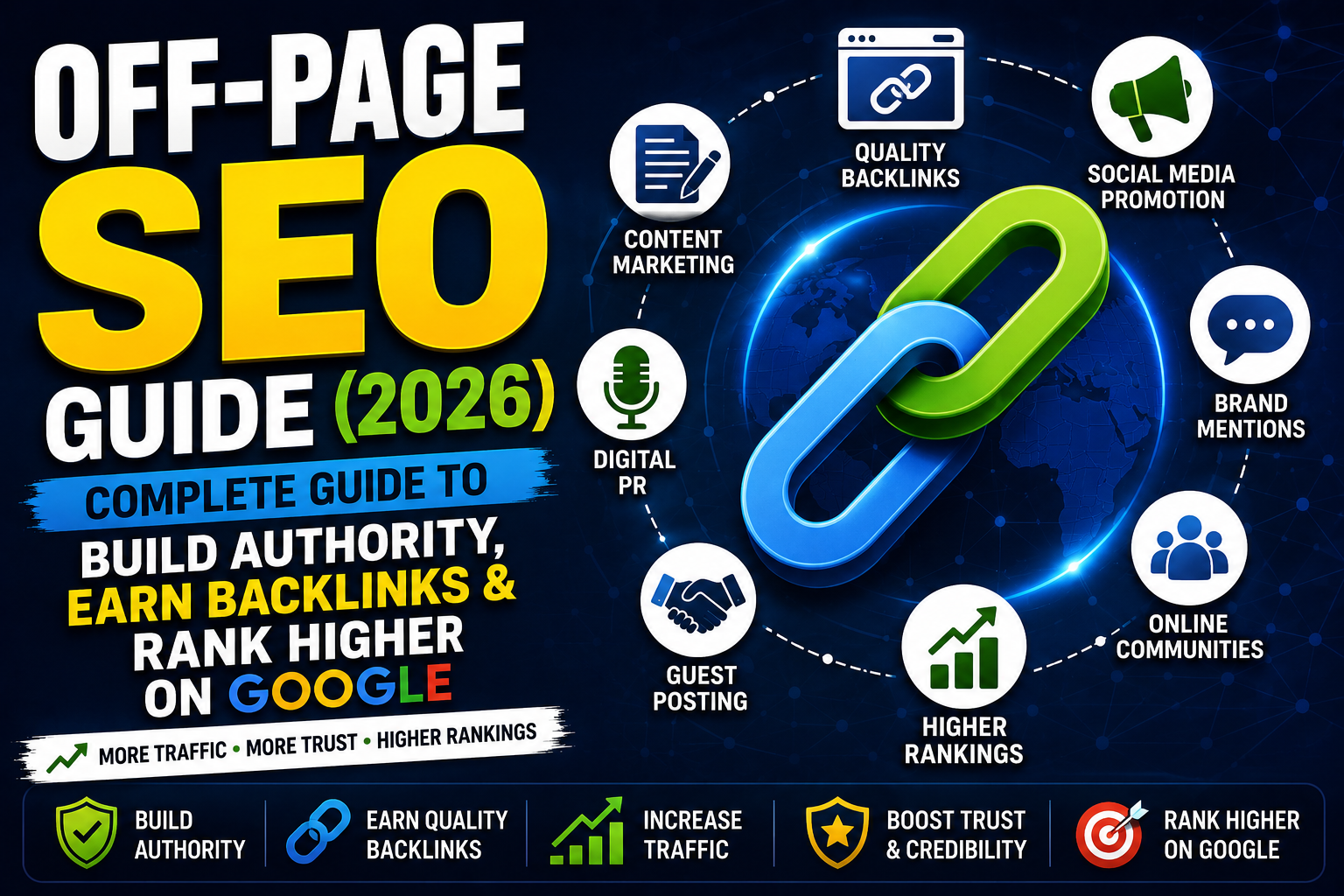
Publishing high-quality content is only half the battle in SEO. To rank consistently on Google, your website also needs authority, trust, and credibility—and that's exactly what Off-Page SEO helps you build.
Off-Page SEO focuses on everything that happens outside your website to improve your search engine rankings. From earning backlinks and brand mentions to building your online reputation, these signals help search engines determine whether your content deserves to rank higher.
In this complete Off-Page SEO Guide, you'll learn the most effective strategies for increasing your website's authority, earning quality backlinks, and driving sustainable organic traffic in 2026.
What is Off-Page SEO?
Off-Page SEO refers to all optimization activities that occur outside your website to improve its visibility and authority in search engines.
Unlike On-Page SEO, which focuses on your content and website structure, Off-Page SEO is about building trust through external signals.
Its main goals are:
Improve Domain Authority
Increase Website Trust
Earn Quality Backlinks
Build Brand Awareness
Improve Search Rankings
Drive Referral Traffic
Why is Off-Page SEO Important?
Google considers backlinks and authority among its strongest ranking signals.
Benefits include:
✅ Higher Google Rankings
✅ Stronger Domain Authority
✅ More Organic Traffic
✅ Better Brand Recognition
✅ Increased Website Trust
✅ Higher Referral Traffic
How Google Evaluates Off-Page SEO
Google looks at factors such as:
Quality of backlinks
Relevance of linking websites
Authority of referring domains
Brand mentions
User engagement
Content popularity
A few high-quality backlinks are far more valuable than hundreds of low-quality ones.
Complete Off-Page SEO Checklist
✅ 1. Build High-Quality Backlinks
Backlinks remain one of the most important ranking factors.
Good backlinks come from:
Trusted websites
Relevant blogs
Industry publications
News websites
Focus on quality over quantity.
✅ 2. Guest Posting
Write valuable articles for other reputable websites in your niche.
Benefits:
Earn backlinks
Reach new audiences
Build authority
Increase referral traffic
✅ 3. Social Media Promotion
Although social signals aren't direct ranking factors, they increase visibility and attract backlinks.
Share your content on:
LinkedIn
X (Twitter)
Pinterest
Facebook
Instagram
Threads
✅ 4. Build Your Personal Brand
People trust recognized experts.
Create content consistently on:
LinkedIn
Medium
YouTube
GitHub (for developers)
A strong personal brand often leads to natural backlinks.
✅ 5. Participate in Online Communities
Answer questions and help others on platforms like:
Reddit
Quora
Stack Overflow
Industry forums
Provide value first and avoid spamming links.
✅ 6. Business Directories
Submit your website to reputable directories.
Examples:
Google Business Profile
Bing Places
Local business directories
Niche directories
✅ 7. Brand Mentions
Google recognizes brand mentions even without clickable links.
Encourage mentions through:
Interviews
Podcasts
Guest articles
Community engagement
✅ 8. Content Marketing
Create content that naturally attracts backlinks:
Ultimate guides
Original research
Case studies
Statistics
Infographics
Checklists
Tutorials
People link to valuable resources.
✅ 9. Broken Link Building
Find broken links on other websites and suggest your relevant content as a replacement.
It's a win-win strategy.
✅ 10. Digital PR
Earn backlinks by:
Publishing industry insights
Launching studies
Sharing newsworthy updates
Collaborating with journalists
✅ 11. Influencer Collaboration
Work with creators in your niche.
They can:
Share your content
Mention your brand
Generate referral traffic
Increase visibility
✅ 12. Podcast Appearances
Being featured on podcasts helps build authority and often earns backlinks from episode pages.
✅ 13. Video Marketing
Repurpose your content into videos.
Platforms include:
YouTube
Instagram Reels
Shorts
TikTok
Video content increases reach and brand awareness.
✅ 14. Email Outreach
Reach out to:
Bloggers
Journalists
Website owners
Industry experts
Share valuable resources—not spam.
✅ 15. Local SEO Citations
If you own a local business:
Maintain consistent:
Business Name
Address
Phone Number (NAP)
Across all directories.
✅ 16. Encourage Reviews
Positive reviews improve credibility.
Collect reviews on:
Google Business Profile
Trustpilot
Facebook
Industry-specific review sites
✅ 17. Build Topical Authority
Publish multiple high-quality articles around one subject.
Example:
SEO Cluster:
What is SEO?
On-Page SEO
Technical SEO
Off-Page SEO
Keyword Research
Google Search Console
Link Building
This strengthens your expertise.
✅ 18. Monitor Your Backlinks
Use tools like:
Google Search Console
Ahrefs
Semrush
Moz
Track:
New backlinks
Lost backlinks
Toxic links
Backlink Types
Natural Backlinks
Earned because your content is valuable.
Best type.
Manual Backlinks
Created through outreach or partnerships.
Self-Created Backlinks
Examples:
Profiles
Forum signatures
Directory listings
Use sparingly.
Backlinks to Avoid
Avoid:
❌ Link Farms
❌ Paid Spam Links
❌ Private Blog Networks (PBNs)
❌ Automated Link Building
❌ Low-Quality Directories
❌ Comment Spam
Google may penalize manipulative link-building practices.
Best Off-Page SEO Tools
Google Search Console
Ahrefs
Semrush
Moz
Majestic
BuzzSumo
Hunter.io
HARO Alternatives
Off-Page SEO Checklist Summary
Before starting your campaign:
✅ Create high-quality content
✅ Earn relevant backlinks
✅ Publish guest posts
✅ Promote on social media
✅ Build your personal brand
✅ Join online communities
✅ Monitor backlinks
✅ Build topical authority
✅ Encourage brand mentions
✅ Track SEO performance
Common Off-Page SEO Mistakes
Avoid:
❌ Buying backlinks
❌ Ignoring content quality
❌ Focusing only on quantity
❌ Spamming forums
❌ Using irrelevant anchor text
❌ Building links too quickly
❌ Ignoring backlink audits
Final Thoughts
Off-Page SEO is about earning trust—not manipulating rankings.
When you consistently create valuable content, build genuine relationships, and earn backlinks from reputable websites, your authority naturally grows.
The best Off-Page SEO strategy is a combination of excellent content, smart promotion, ethical link building, and strong brand presence.
Remember: quality always beats quantity.
Frequently Asked Questions (FAQs)
1. What is Off-Page SEO?
Off-Page SEO refers to activities outside your website—such as backlinks, brand mentions, and social promotion—that improve your authority and search engine rankings.
2. Why are backlinks important?
Backlinks act as votes of confidence. High-quality backlinks from trusted websites can improve your site's credibility and rankings.
3. Does social media improve SEO?
Social media isn't a direct ranking factor, but it increases content visibility, attracts backlinks, and builds brand awareness.
4. How can beginners build backlinks?
Start with guest posting, creating high-quality content, participating in online communities, submitting to relevant directories, and promoting your content on social media.
5. Is buying backlinks safe?
No. Buying low-quality or spammy backlinks violates Google's guidelines and may result in ranking penalties.
6. How long does Off-Page SEO take to show results?
Off-Page SEO is a long-term strategy. Depending on competition and consistency, noticeable improvements often take 3–6 months or longer.