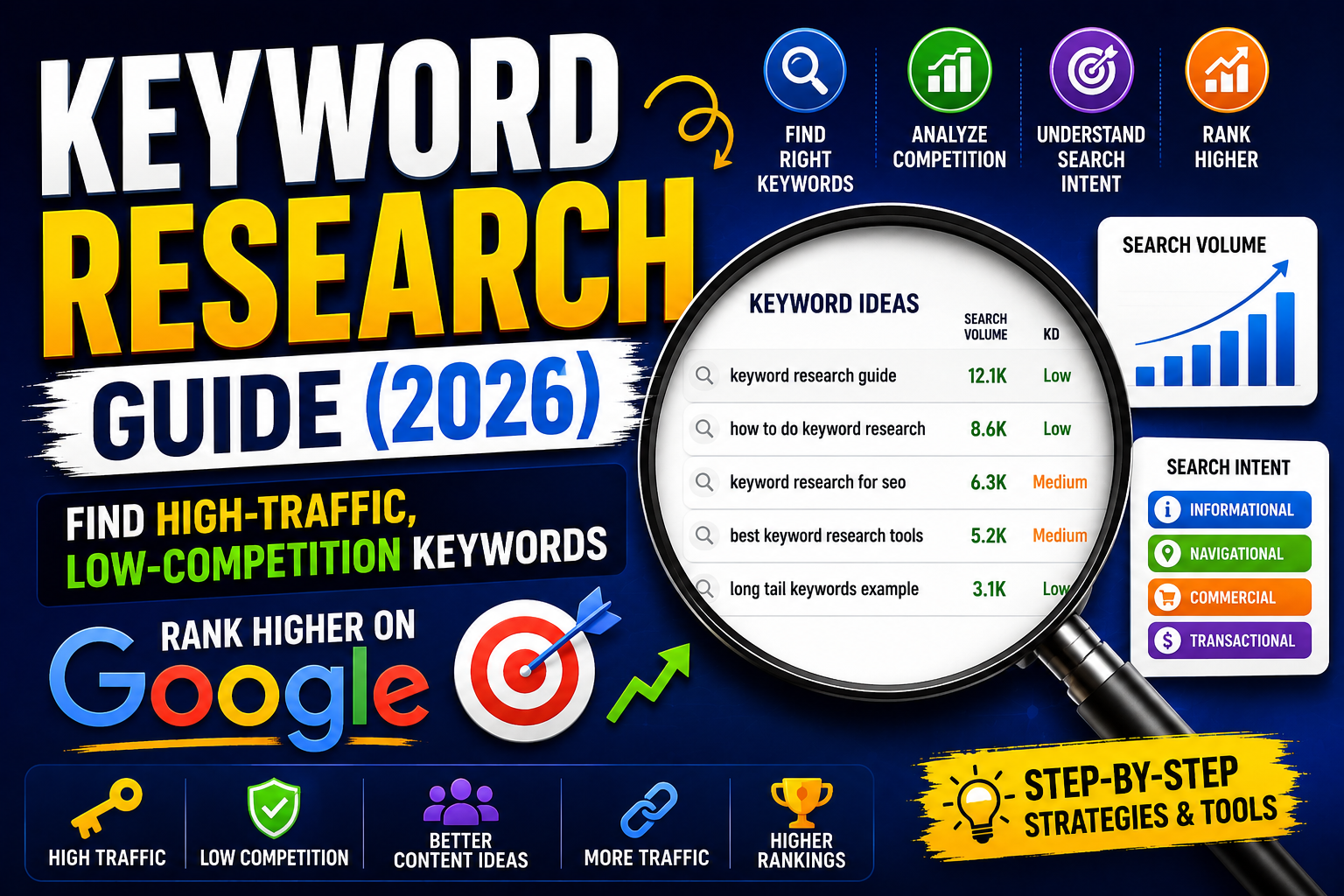
Keyword Research Guide (2026): How to Find High-Traffic, Low-Competition Keywords
Introduction
Keyword research is the foundation of every successful SEO strategy. No matter how well-written your content is, it won't rank if you're targeting the wrong keywords.
Understanding what your audience is searching for helps you create content that matches their intent, attracts organic traffic, and improves your chances of ranking on Google.
In this complete Keyword Research Guide, you'll learn how to find profitable keywords, understand search intent, analyze competition, and choose the best keywords for your website in 2026.
What is Keyword Research?
Keyword research is the process of finding the words and phrases people type into search engines like Google, Bing, and AI-powered search engines.
These keywords help you understand:
What your audience wants
How often people search for a topic
How difficult it is to rank
Which topics have the highest traffic potential
Why is Keyword Research Important?
Good keyword research helps you:
✅ Increase Organic Traffic
✅ Rank Higher on Google
✅ Understand User Intent
✅ Create Better Content
✅ Improve Conversions
✅ Build Topical Authority
Without keyword research, you're simply guessing what people are searching for.
Types of Keywords
1. Short-Tail Keywords
Broad keywords with high search volume.
Examples:
SEO
AI
Blogging
Pros:
High traffic
Cons:
Very competitive
2. Long-Tail Keywords
Longer and more specific phrases.
Examples:
Keyword Research Guide
Best AI Tools for Students
How to Rank a Blogger Website
Pros:
Lower competition
Higher conversion rates
Easier to rank
3. Informational Keywords
Users looking to learn something.
Examples:
What is SEO?
How does Google work?
What is keyword research?
4. Navigational Keywords
Users searching for a specific brand or website.
Examples:
Google Search Console
ChatGPT
Decode With Jai
5. Commercial Keywords
Users comparing products or services.
Examples:
Best SEO Tools
Ahrefs vs Semrush
Best AI Writing Tools
6. Transactional Keywords
Users ready to take action.
Examples:
Buy hosting
SEO course
AI software subscription
Understanding Search Intent
Google ranks pages that match user intent.
The four main search intents are:
Informational
User wants knowledge.
Example:
"What is SEO?"
Navigational
User wants a specific website.
Example:
"Google Analytics Login"
Commercial Investigation
User is comparing options.
Example:
"Best SEO Plugins"
Transactional
User is ready to buy or sign up.
Example:
"Buy Domain Name"
How to Find Keywords
Method 1: Google Autocomplete
Start typing a topic into Google.
Google suggests popular searches automatically.
Method 2: People Also Ask
Use Google's "People Also Ask" section for question-based content ideas.
Method 3: Related Searches
Scroll to the bottom of Google's search results for additional keyword ideas.
Method 4: Google Trends
Discover trending topics and seasonal keyword popularity.
Method 5: Google Keyword Planner
Find:
Search volume
Competition
Keyword suggestions
Method 6: Competitor Analysis
Analyze competitor websites to discover keywords they rank for.
Best Keyword Research Tools
Free Tools
Google Keyword Planner
Google Trends
Google Search Console
Google Autocomplete
Google People Also Ask
AnswerThePublic (Free Version)
Paid Tools
Ahrefs
Semrush
Moz
KWFinder
Ubersuggest
Keyword Metrics Explained
Search Volume
Average monthly searches for a keyword.
Higher volume usually means more competition.
Keyword Difficulty (KD)
Measures how difficult it is to rank.
For new websites:
Target:
Low to Medium Difficulty
Cost Per Click (CPC)
Useful for commercial keywords.
Higher CPC often indicates stronger buying intent.
Search Intent
Always prioritize matching the user's intent over simply targeting high-volume keywords.
Where to Use Keywords
Place your primary keyword naturally in:
✅ SEO Title
✅ URL
✅ Meta Description
✅ First 100 Words
✅ H1 Heading
✅ H2 Headings
✅ Image ALT Text
✅ Conclusion
Avoid keyword stuffing.
Keyword Clustering
Instead of targeting one keyword, target multiple related keywords in one article.
Example:
Primary Keyword:
Keyword Research Guide
Related Keywords:
SEO Keyword Research
Long-Tail Keywords
Google Keyword Planner
Search Intent
Keyword Difficulty
Keyword Research Tools
This helps your content rank for multiple searches.
Common Keyword Research Mistakes
Avoid:
❌ Targeting only high-volume keywords
❌ Ignoring search intent
❌ Keyword stuffing
❌ Using unrelated keywords
❌ Ignoring long-tail keywords
❌ Not updating old content
AI for Keyword Research
AI can make keyword research faster and more efficient.
Use AI to:
Generate keyword ideas
Identify search intent
Create topic clusters
Build content outlines
Analyze competitors
Suggest FAQs
Popular AI tools:
ChatGPT
Google Gemini
Claude AI
Perplexity AI
AI should support your strategy—not replace data from trusted SEO tools.
Best Practices for Keyword Research
✔ Focus on user intent
✔ Target long-tail keywords
✔ Build topical authority
✔ Analyze competitors
✔ Update keyword strategy regularly
✔ Combine AI with SEO tools
✔ Monitor rankings using Google Search Console
Final Thoughts
Keyword research is the starting point of every successful SEO campaign.
By choosing the right keywords, understanding search intent, and creating high-quality content around those topics, you increase your chances of ranking higher, attracting more visitors, and growing your website sustainably.
Remember: don't chase only high-volume keywords. Focus on relevance, user intent, and providing genuine value.
Frequently Asked Questions (FAQs)
1. What is keyword research?
Keyword research is the process of identifying the words and phrases people use in search engines to find information, products, or services.
2. Why is keyword research important for SEO?
It helps you understand user intent, target the right audience, create relevant content, and improve your chances of ranking higher in search results.
3. Which free keyword research tools are best?
Google Keyword Planner, Google Trends, Google Search Console, Google Autocomplete, and AnswerThePublic are excellent free tools.
4. What is a long-tail keyword?
A long-tail keyword is a longer, more specific search phrase with lower competition and often higher conversion potential.
5. How many keywords should I target in one article?
Focus on one primary keyword and naturally include several related secondary keywords to cover the topic comprehensively.
6. Can AI replace keyword research tools?
No. AI is great for brainstorming and content planning, but reliable keyword data such as search volume and keyword difficulty should come from SEO tools like Google Keyword Planner, Ahrefs, or Semrush.