Future of AI Jobs: How Artificial Intelligence Will Transform Careers in 2026 and Beyond
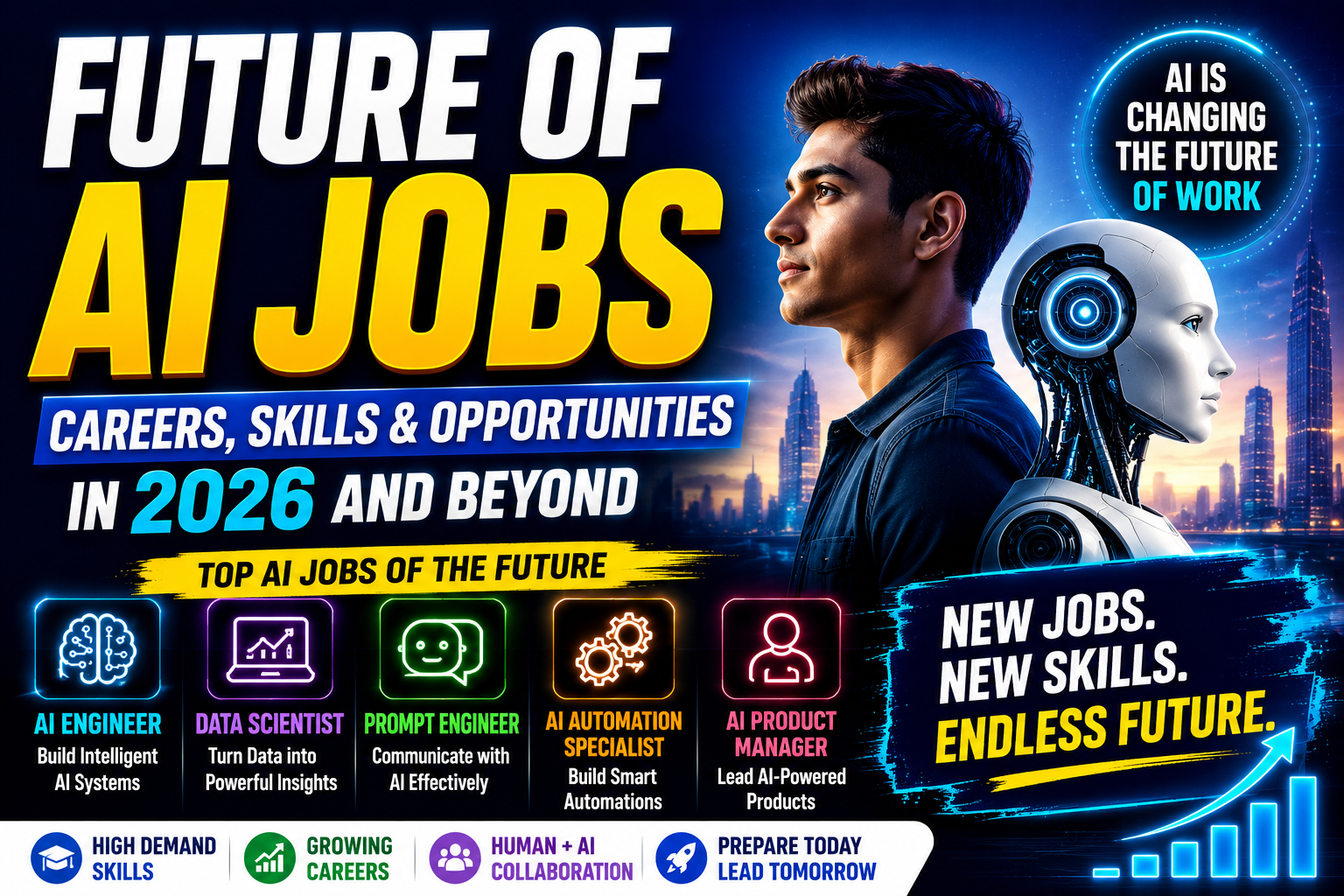
Introduction
Artificial Intelligence (AI) is reshaping the global workforce at an unprecedented pace. From automating repetitive tasks to assisting professionals with complex decision-making, AI is changing how people work across nearly every industry.
While many fear that AI will replace jobs, the reality is more balanced. AI is eliminating certain routine tasks, creating entirely new career opportunities, and increasing demand for professionals who can work alongside intelligent systems.
In 2026, understanding the future of AI jobs is essential for students, job seekers, professionals, freelancers, entrepreneurs, and business leaders who want to stay competitive in an AI-driven economy.
In this guide, we'll explore how AI is transforming the job market, which careers are growing, the skills you'll need, and how to prepare for the future of work.
What Are AI Jobs?
AI jobs are careers that involve developing, managing, implementing, or working alongside Artificial Intelligence technologies.
These include roles such as:
AI Engineer
Machine Learning Engineer
Data Scientist
Prompt Engineer
AI Product Manager
AI Researcher
AI Consultant
AI Trainer
AI Ethics Specialist
However, AI isn't limited to technical roles. Professionals in marketing, finance, healthcare, education, HR, design, and customer service are also increasingly using AI tools in their daily work.
How AI is Changing the Job Market
Artificial Intelligence is changing work in three major ways:
1. Automating Repetitive Tasks
AI can automate:
Data entry
Report generation
Customer support
Email responses
Scheduling
Basic coding
Administrative tasks
This allows employees to focus on more strategic and creative work.
2. Creating New Career Opportunities
AI is generating demand for entirely new roles, including:
AI Prompt Engineers
AI Automation Specialists
AI Workflow Designers
AI Content Strategists
AI Trainers
AI Consultants
These jobs barely existed a few years ago but are becoming increasingly important.
3. Enhancing Human Productivity
Rather than replacing professionals, AI often acts as a productivity partner.
Developers write code faster, marketers create campaigns more efficiently, and designers generate ideas more quickly using AI-powered tools.
Industries Most Affected by AI
Technology
Software development, cybersecurity, and cloud computing continue to integrate AI into daily workflows.
Healthcare
AI assists with:
Medical imaging
Diagnosis support
Drug discovery
Patient monitoring
Finance
Financial institutions use AI for:
Fraud detection
Risk analysis
Investment research
Customer support
Marketing
AI powers:
Content creation
SEO
Social media
Advertising
Customer analytics
Education
AI enables:
Personalized learning
Automated grading
Research assistance
Course creation
Manufacturing
Factories use AI for:
Quality control
Predictive maintenance
Robotics
Supply chain optimization
Fastest Growing AI Careers in 2026
AI Engineer
Designs and builds AI systems and applications.
Machine Learning Engineer
Develops machine learning models and intelligent algorithms.
Data Scientist
Analyzes large datasets to generate business insights.
Prompt Engineer
Creates optimized prompts for AI tools to produce accurate and useful outputs.
AI Product Manager
Leads AI-powered product development and strategy.
AI Automation Specialist
Builds automated workflows using AI tools and platforms.
AI Consultant
Helps organizations adopt and implement AI technologies effectively.
AI Research Scientist
Develops new AI models and explores cutting-edge innovations.
Skills Needed for Future AI Jobs
Technical Skills
Python
SQL
Machine Learning
Data Analysis
Cloud Computing
API Integration
AI Tool Proficiency
Professionals should learn tools such as:
ChatGPT
Claude AI
Google Gemini
Microsoft Copilot
GitHub Copilot
Perplexity AI
Soft Skills
As AI handles routine tasks, human skills become even more valuable.
These include:
Critical Thinking
Creativity
Communication
Leadership
Problem Solving
Adaptability
Jobs AI Is Most Likely to Automate
AI is most effective at automating repetitive and rule-based tasks, including:
Basic data entry
Simple customer support
Appointment scheduling
Routine bookkeeping
Basic report generation
Document summarization
Automation doesn't always eliminate jobs—it often changes how those jobs are performed.
Jobs That Will Continue to Need Human Expertise
Many careers rely on judgment, empathy, creativity, or interpersonal skills, including:
Healthcare Professionals
Teachers
Lawyers
Psychologists
Business Leaders
Sales Professionals
Creative Directors
UX Designers
These roles are likely to incorporate AI rather than be replaced by it.
How Students Can Prepare
Students should focus on:
✅ Learning AI fundamentals
✅ Building digital skills
✅ Practicing prompt engineering
✅ Understanding data analysis
✅ Creating AI-assisted projects
Hands-on experience is often more valuable than theory alone.
How Professionals Can Stay Relevant
Working professionals can prepare by:
Learning AI tools used in their industry
Automating repetitive tasks
Upskilling through online courses
Building AI-enhanced workflows
Staying informed about AI developments
Continuous learning will be key.
Challenges of the AI Job Market
Despite its opportunities, AI also presents challenges.
Skill Gaps
Workers may need retraining as technology evolves.
Ethical Concerns
Organizations must ensure AI is used responsibly and transparently.
Workforce Transition
Some roles will change significantly, requiring employees to adapt.
Future Trends in AI Careers
Over the next decade, we can expect:
🤖 AI Agents managing business workflows
🧠 More AI-human collaboration
🌍 Remote AI-powered jobs
📊 Increased demand for AI specialists
🔒 Growth in AI governance and ethics roles
📈 Expansion of AI across every industry
Will AI Replace Jobs?
The more accurate question is:
Which tasks will AI replace, and which new opportunities will it create?
History shows that major technologies often automate certain tasks while creating new industries and career paths.
Professionals who learn to use AI effectively are likely to be better positioned than those who ignore it.
Final Thoughts
The future of AI jobs isn't about humans versus machines—it's about humans working alongside intelligent technology.
Artificial Intelligence will continue transforming industries, automating repetitive work, and creating exciting new career opportunities.
Success in the AI era will depend on adaptability, continuous learning, and the ability to combine technical knowledge with uniquely human skills such as creativity, communication, and critical thinking.
Whether you're a student planning your career or a professional preparing for the future, now is the best time to start learning AI.
Those who embrace AI today will be better prepared for the jobs of tomorrow.
What do you think the future of AI jobs will look like? Share your thoughts in the comments below!