ChatGPT Prompt Engineering Guide 2026: Master the Art of Writing Better AI Prompts
Introduction
ChatGPT has become one of the most powerful AI tools available today. However, the quality of its responses depends heavily on the quality of your prompts.
This is where Prompt Engineering comes in.
Prompt Engineering is the skill of designing effective instructions that help AI generate accurate, useful, and high-quality responses.
Whether you're a student, content creator, marketer, developer, entrepreneur, or business professional, learning prompt engineering can dramatically improve your results with ChatGPT.
In this complete guide, you'll learn what prompt engineering is, why it matters, and how to write prompts like a professional in 2026.
What Is Prompt Engineering?
Prompt Engineering is the process of creating structured instructions that guide AI models toward producing desired outputs.
Think of ChatGPT as a highly intelligent assistant.
If you give vague instructions, you'll often get generic results.
If you provide detailed instructions, you'll receive more accurate and valuable responses.
Example
Weak Prompt
Write a blog about SEO.
Strong Prompt
Act as an SEO expert.
Write a 2000-word beginner-friendly blog about SEO in 2026. Include an introduction, ranking factors, on-page SEO tips, technical SEO, FAQs, and a conclusion.
The second prompt gives ChatGPT a much clearer understanding of the task.
Why Prompt Engineering Matters
Better prompts can help you:
✅ Generate better content
✅ Improve coding results
✅ Save time
✅ Increase productivity
✅ Get more accurate answers
✅ Create higher-quality outputs
Prompt engineering is becoming one of the most valuable AI skills in the modern workplace.
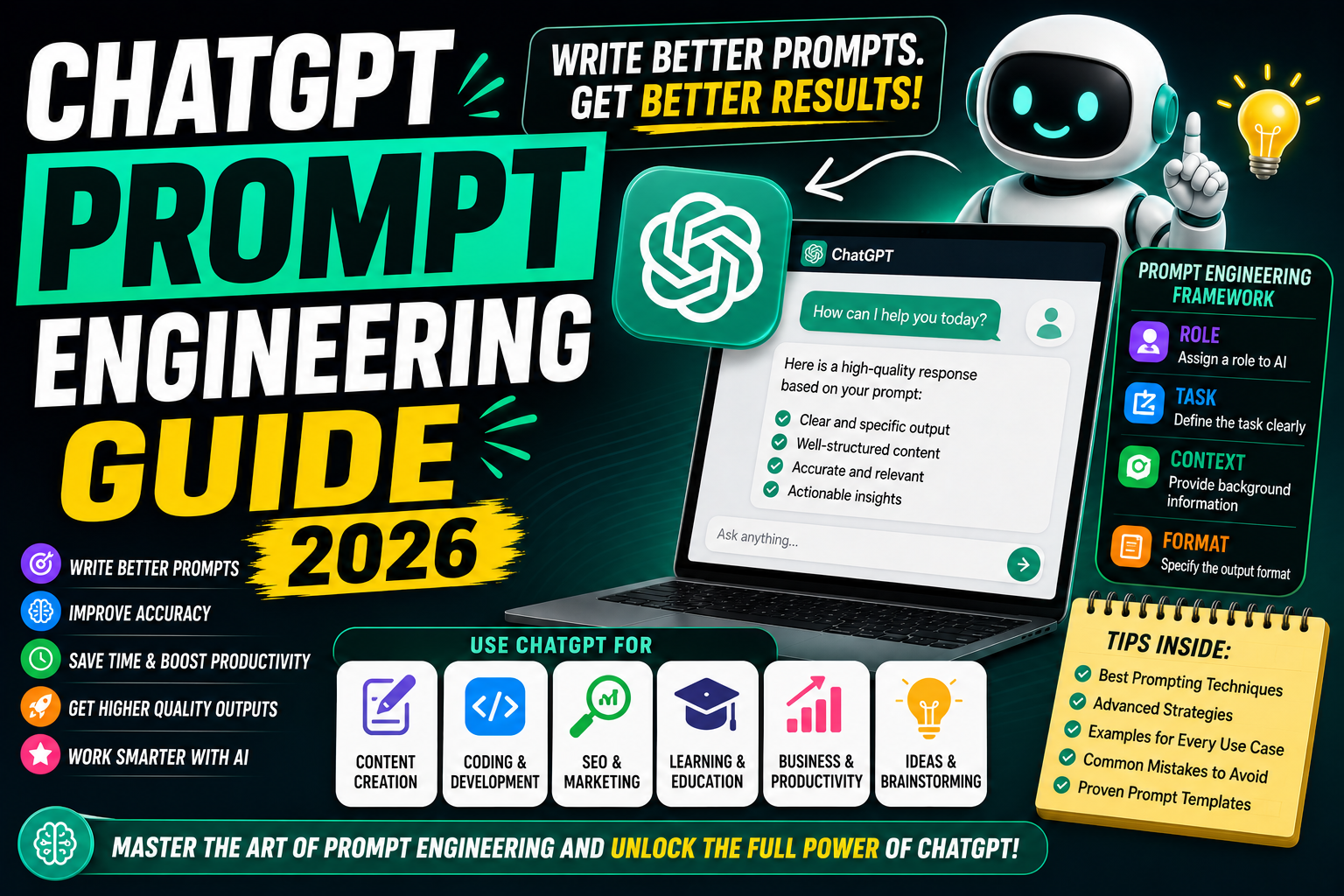
The Four-Part Prompt Framework
One of the most effective frameworks is:
ROLE
Who should the AI act as?
TASK
What should the AI do?
CONTEXT
What background information should it know?
FORMAT
How should the output be structured?
Example Framework
ROLE
Act as an experienced digital marketing consultant.
TASK
Create a content strategy.
CONTEXT
The business is a startup agency offering SEO and social media services.
FORMAT
Provide a 30-day content calendar in table format.
This structure consistently produces better results.
Technique 1: Assign a Role
Roles help AI generate more specialized responses.
Examples
Act as:
SEO Expert
Software Engineer
Marketing Consultant
Data Scientist
Career Coach
Content Strategist
Example
Act as a senior WordPress developer.
Explain how to improve website speed.
This usually performs better than a generic request.
Technique 2: Add Context
Context is one of the most important parts of prompt engineering.
Example
I run a technology blog called Decode With Jai focused on AI, SEO, and digital marketing.
Suggest 50 SEO-friendly blog topics.
The extra information helps ChatGPT provide more relevant recommendations.
Technique 3: Define the Audience
Tell ChatGPT who the content is for.
Example
Explain machine learning to a complete beginner.
Example
Explain machine learning to experienced software engineers.
The outputs will be very different.
Technique 4: Specify the Format
Many users forget this step.
Examples
Create:
Bullet points
Table
Blog article
LinkedIn post
X thread
Pinterest description
FAQ section
Example
Create a LinkedIn post with:
Hook
Three key points
CTA
Hashtags
Technique 5: Set Constraints
Constraints improve focus.
Examples
Write:
Under 300 words
For beginners
In simple English
Without technical jargon
This prevents overly complex outputs.
Technique 6: Ask for Multiple Options
Instead of:
Create a headline.
Try:
Create 10 headline variations.
This gives you more creative choices.
Technique 7: Use Step-by-Step Instructions
Complex tasks perform better when broken into steps.
Example
Step 1:
Analyze the website.
Step 2:
Identify SEO issues.
Step 3:
Prioritize improvements.
Step 4:
Create an action plan.
Structured prompts often outperform single large requests.
Technique 8: Use Iterative Prompting
Professionals rarely stop after one prompt.
Example Workflow
Prompt 1:
Create blog outline.
Prompt 2:
Expand introduction.
Prompt 3:
Write FAQs.
Prompt 4:
Optimize for SEO.
Prompt 5:
Create social media content.
This process produces higher-quality results.
Prompt Engineering for Content Creation
Blog Writing Prompt
Act as an SEO content writer.
Write a 2000-word article on "Best AI Productivity Tools in 2026."
Include:
Introduction
Features
Comparison Table
FAQs
Conclusion
Optimize for SEO.
Prompt Engineering for SEO
SEO Prompt
Act as an SEO expert.
Analyze this blog post and suggest:
SEO title
Meta description
Focus keyword
Internal linking opportunities
Prompt Engineering for Coding
Coding Prompt
Act as a senior full-stack developer.
Create a responsive landing page using HTML, CSS, and JavaScript.
Include:
Hero section
Features section
Testimonials
CTA
Mobile responsiveness
Prompt Engineering for Marketing
Marketing Prompt
Act as a digital marketing strategist.
Create a Meta Ads campaign for a web development agency.
Include:
Audience targeting
Ad copy
Budget
CTA
Advanced Prompt Engineering Techniques
Chain-of-Thought Prompting
Ask AI to explain reasoning step-by-step.
Example
Solve this problem step-by-step and explain your reasoning.
Few-Shot Prompting
Provide examples before requesting output.
Example
Example:
Headline:
Boost Your Productivity with AI
Headline:
Top AI Tools for Marketers
Now create 10 similar headlines.
Reverse Prompting
Ask AI what information it needs.
Example
Before answering, ask me any questions required to generate the best result.
Common Prompt Engineering Mistakes
Being Too Vague
❌ Write content.
✅ Write a 1500-word SEO blog for beginners.
No Context
Always provide relevant background information.
No Format Instructions
Specify exactly how you want the output.
Expecting Perfection
Review and refine responses.
AI works best through collaboration.
Best Prompt Template
You can use this template for almost any task:
Act as a [ROLE].
Your task is to [TASK].
Context:
[BACKGROUND INFORMATION]
Requirements:
Requirement 1
Requirement 2
Requirement 3
Output Format:
[FORMAT]
Target Audience:
[AUDIENCE]
Tone:
[PROFESSIONAL / CASUAL / FRIENDLY]
Future of Prompt Engineering
As AI becomes more powerful, prompt engineering will remain an essential skill.
Future developments may include:
AI agents
Automated prompt optimization
Voice prompting
Multi-modal prompting
Personalized AI workflows
People who understand prompt engineering will continue to gain significant productivity advantages.
Final Thoughts
Prompt engineering is one of the most valuable AI skills you can learn in 2026.
By providing clear instructions, context, roles, formats, and constraints, you can dramatically improve the quality of ChatGPT's responses.
Whether you're creating content, building software, optimizing SEO, learning new skills, or growing a business, effective prompt engineering can help you unlock the full power of AI.
The better your prompts, the better your results.
What is your favorite ChatGPT prompt engineering technique? Share it in the comments below!