Best AI Research Tools in 2026: Find Information Faster and Smarter
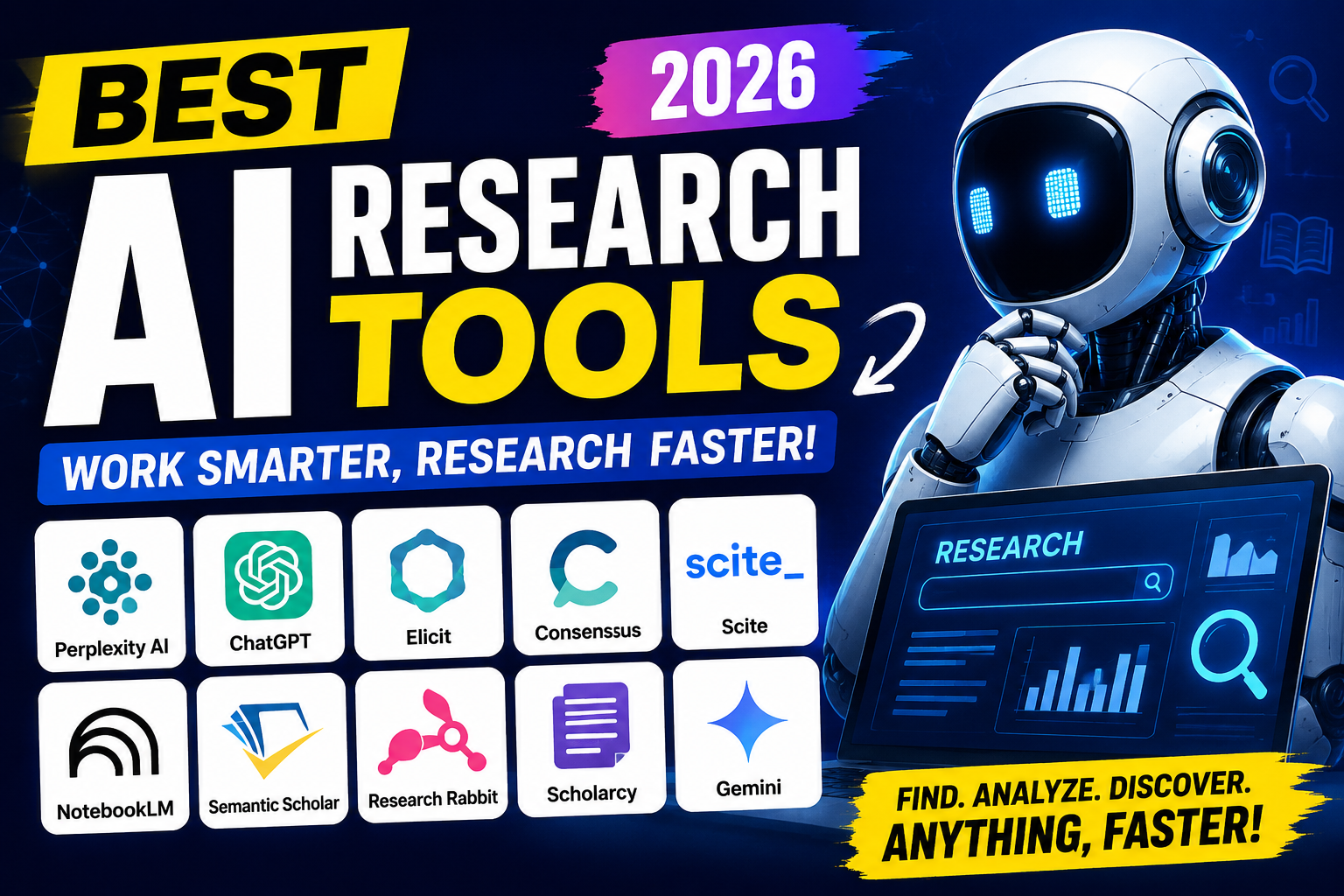
Artificial Intelligence is transforming the way researchers, students, content creators, marketers, developers, and business professionals gather information. Instead of spending hours searching through websites, journals, and reports, AI research tools can now summarize, analyze, organize, and even discover insights within seconds.
Whether you're writing academic papers, creating content, conducting market research, or analyzing industry trends, AI-powered research tools can significantly boost productivity and accuracy.
In this guide, we'll explore the best AI research tools in 2026 and help you choose the right one for your needs.
Why Use AI Research Tools?
AI research tools help users:
✅ Find relevant information quickly
✅ Summarize lengthy articles and reports
✅ Generate citations automatically
✅ Analyze large datasets
✅ Discover hidden insights
✅ Save hours of manual research
✅ Improve content accuracy
1. Perplexity AI
Best For:
Fast web research and fact-based answers
Perplexity AI has become one of the most popular AI research assistants available today. Unlike traditional search engines, it provides direct answers along with source citations.
Key Features:
- Real-time web search
- Source citations
- Deep research mode
- Academic references
- Follow-up questions
Pros:
- Accurate answers
- Reliable sources
- Fast research workflow
Cons:
- Advanced features require Pro plan
Pricing:
- Free Plan Available
- Pro Plan Available
2. ChatGPT
Best For:
General research and content creation
ChatGPT has evolved into a powerful research assistant capable of analyzing documents, summarizing reports, brainstorming ideas, and helping users understand complex topics.
Key Features:
- Research assistance
- File analysis
- Data interpretation
- Content generation
- Coding support
Pros:
- Versatile
- Easy to use
- Excellent explanations
Cons:
- Some advanced features require premium plans
Pricing:
- Free Plan
- Plus & Pro Plans
3. Elicit
Best For:
Academic research
Elicit is specifically designed for researchers and students. It can search academic papers, summarize findings, and identify relevant studies based on your research question.
Key Features:
- Research paper search
- Literature review assistance
- Academic summaries
- Citation support
Pros:
- Excellent for academics
- Research-focused workflow
Cons:
- Limited for non-academic research
Pricing:
- Free & Paid Plans
4. Consensus
Best For:
Scientific evidence research
Consensus uses AI to search scientific papers and provide evidence-backed answers.
Key Features:
- Scientific paper database
- Evidence summaries
- Research-backed conclusions
- Academic search engine
Pros:
- Highly reliable
- Great for healthcare and science topics
Cons:
- Mainly focused on scientific literature
Pricing:
- Free & Premium Plans
5. Scite
Best For:
Citation analysis
Scite helps researchers understand how academic papers are cited by other studies.
Key Features:
- Smart citations
- Citation context
- Research validation
- Academic analytics
Pros:
- Improves research credibility
- Excellent citation insights
Cons:
- Primarily academic
Pricing:
- Paid Plans Available
6. NotebookLM
Best For:
Research from personal documents
NotebookLM allows users to upload PDFs, notes, websites, and documents while using AI to generate summaries, insights, and research notes.
Key Features:
- Document-based research
- AI summaries
- Source-grounded answers
- Audio overview generation
Pros:
- Great for studying
- Supports large documents
Cons:
- Requires source uploads
Pricing:
- Free and Premium Versions
7. Semantic Scholar
Best For:
Academic paper discovery
Semantic Scholar uses AI to help users discover important research papers and understand research trends.
Key Features:
- AI-powered paper recommendations
- Citation tracking
- Research insights
- Academic search
Pros:
- Massive research database
- Free access
Cons:
- Academic-focused
Pricing:
- Free
8. Research Rabbit
Best For:
Research paper visualization
Research Rabbit provides visual research maps that help users discover related papers and authors.
Key Features:
- Research network visualization
- Citation mapping
- Author tracking
- Literature exploration
Pros:
- Unique visual approach
- Excellent for literature reviews
Cons:
- Learning curve for beginners
Pricing:
- Free
9. Scholarcy
Best For:
Research paper summarization
Scholarcy can convert lengthy academic papers into concise summaries and flashcards.
Key Features:
- Automatic summaries
- Key findings extraction
- Flashcards
- Citation extraction
Pros:
- Saves reading time
- Student-friendly
Cons:
- Limited outside academic use
Pricing:
- Free Trial Available
10. Gemini
Best For:
Research integrated with Google ecosystem
Gemini provides powerful research capabilities with access to Google services, making it useful for students, professionals, and businesses.
Key Features:
- Web research
- Deep Research mode
- Google Workspace integration
- Data analysis
Pros:
- Strong ecosystem integration
- Excellent research workflow
Cons:
- Some features require premium plans
Pricing:
- Free & Advanced Plans
Comparison Table
| Tool | Best For | Free Plan |
|---|---|---|
| Perplexity AI | Web Research | ✅ |
| ChatGPT | General Research | ✅ |
| Elicit | Academic Research | ✅ |
| Consensus | Scientific Research | ✅ |
| Scite | Citation Analysis | ❌ |
| NotebookLM | Document Research | ✅ |
| Semantic Scholar | Research Papers | ✅ |
| Research Rabbit | Literature Discovery | ✅ |
| Scholarcy | Paper Summaries | Trial |
| Gemini | Deep Research | ✅ |
Which AI Research Tool Should You Choose?
For Students
- Elicit
- Consensus
- Semantic Scholar
- NotebookLM
For Content Creators
- ChatGPT
- Perplexity AI
- Gemini
For Academic Researchers
- Scite
- Elicit
- Research Rabbit
- Consensus
For Business Professionals
- ChatGPT
- Gemini
- Perplexity AI
Final Thoughts
AI research tools are revolutionizing how we discover, analyze, and understand information. Whether you're conducting academic research, creating content, studying for exams, or making business decisions, these tools can dramatically improve efficiency and accuracy.
For most users, a combination of ChatGPT, Perplexity AI, and NotebookLM provides an excellent research workflow. Academic researchers may benefit more from Elicit, Consensus, Scite, and Research Rabbit.
As AI technology continues to evolve throughout 2026, research is becoming faster, smarter, and more accessible than ever before.
Frequently Asked Questions (FAQs)
Q: What is the best AI research tool in 2026?
A: Perplexity AI, ChatGPT, and NotebookLM are among the best overall AI research tools.
Q: Which AI tool is best for academic research?
A: Elicit, Consensus, Scite, and Semantic Scholar are excellent choices for academic research.
Q: Are AI research tools free?
A: Many tools offer free plans, though advanced features may require paid subscriptions.
Q: Can AI research tools replace traditional research?
A: No. AI tools can accelerate research, but human verification and critical thinking remain essential.