AI Myths vs Reality: Debunking the Biggest Artificial Intelligence Misconceptions in 2026
Introduction
Artificial Intelligence (AI) has become one of the most talked-about technologies in the world. From ChatGPT and Google Gemini to AI-powered business automation and self-driving cars, AI is transforming industries and changing how we work, learn, and communicate.
However, with its rapid growth comes misinformation.
Many people believe AI will replace all jobs, become smarter than humans overnight, or completely eliminate human creativity. While AI is incredibly powerful, many of these beliefs are myths rather than reality.
In this guide, we'll separate fact from fiction by exploring the biggest AI myths and the realities behind them.
Why Understanding AI Matters
AI is already influencing:
Business
Education
Healthcare
Software Development
Marketing
Finance
Customer Support
Understanding what AI can—and cannot—do helps individuals and businesses make informed decisions.
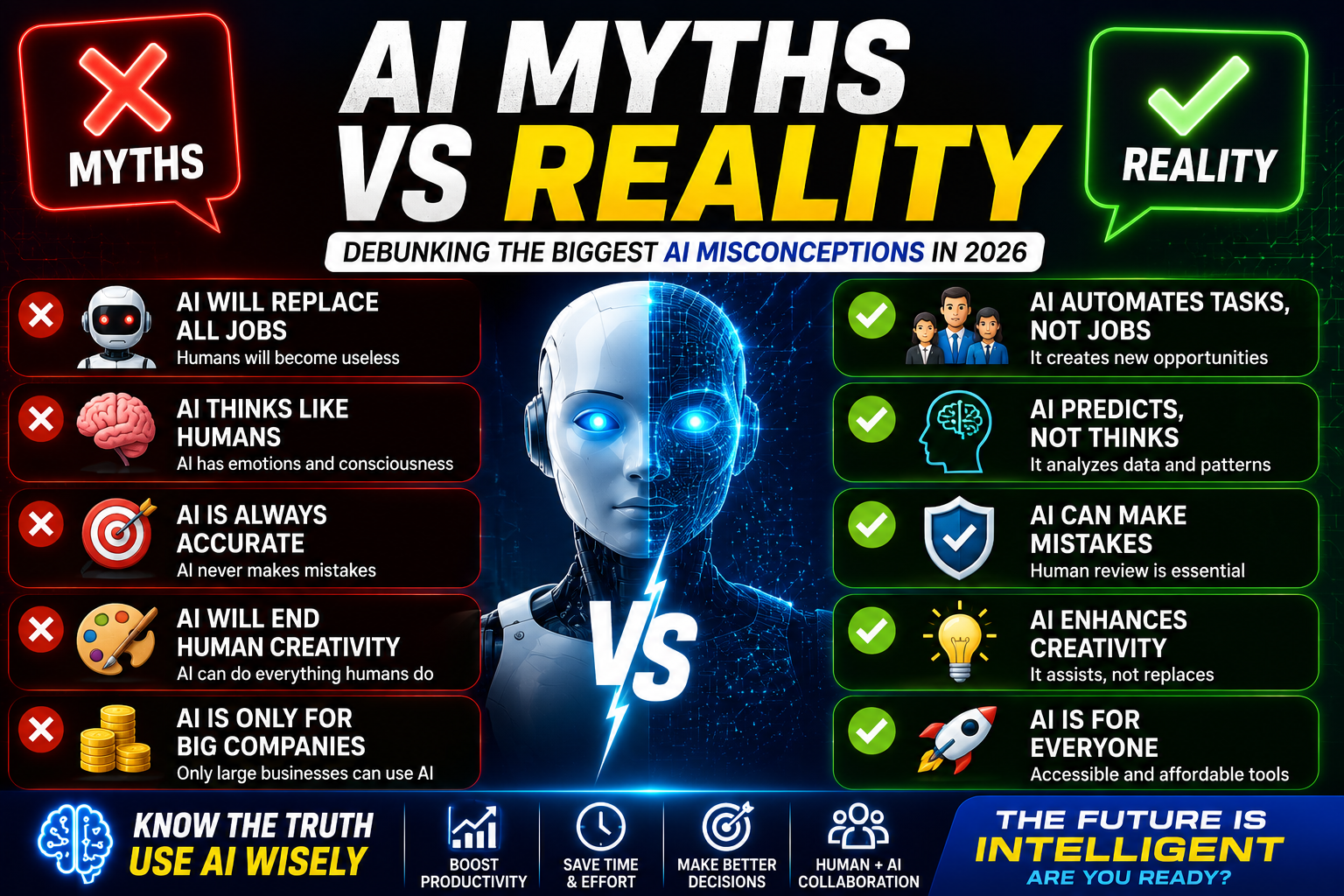
Myth 1: AI Will Replace All Human Jobs
Reality
AI is more likely to automate repetitive tasks than eliminate entire professions.
While certain routine jobs may change, AI is also creating new career opportunities such as:
AI Engineer
Prompt Engineer
AI Consultant
AI Product Manager
AI Automation Specialist
Most professionals will work alongside AI rather than be replaced by it.
Myth 2: AI Thinks Like Humans
Reality
AI does not think, feel, or understand the world like humans.
It predicts patterns based on data and algorithms.
It cannot:
Feel emotions
Form personal opinions
Understand experiences the way humans do
AI generates responses based on probabilities, not consciousness.
Myth 3: AI is Always Accurate
Reality
AI can make mistakes.
Sometimes it may:
Generate incorrect information
Misinterpret prompts
Produce outdated responses
Hallucinate facts
Users should always verify important information before relying on it.
Myth 4: AI Can Replace Human Creativity
Reality
AI can assist creativity, but it doesn't replace original human ideas.
AI helps with:
Brainstorming
Drafting
Design inspiration
Content generation
Human creativity, storytelling, emotion, and originality remain essential.
Myth 5: AI is Only for Large Companies
Reality
Today, AI is accessible to everyone.
Students, freelancers, creators, startups, and small businesses can use AI tools for:
Writing
Coding
Design
Marketing
Research
Productivity
Many AI tools even offer free plans.
Myth 6: AI Will Become Smarter Than Humans Overnight
Reality
AI is advancing rapidly, but progress is gradual.
Current AI systems are designed for specific tasks and still require:
Human supervision
Training
Ethical guidelines
Continuous improvement
General Artificial Intelligence (AGI) remains an active area of research.
Myth 7: AI Doesn't Need Humans
Reality
AI depends heavily on human expertise.
People are needed to:
Build AI models
Train systems
Write prompts
Review outputs
Make decisions
Ensure ethical use
AI works best when combined with human intelligence.
Myth 8: AI Can Solve Every Problem
Reality
AI is a powerful tool—but not a universal solution.
Some challenges require:
Human judgment
Emotional intelligence
Leadership
Ethics
Creativity
AI should support decision-making, not replace it entirely.
Myth 9: AI is Too Expensive
Reality
Many AI tools are affordable or free.
Popular options include:
ChatGPT
Google Gemini
Claude AI
Perplexity AI
Microsoft Copilot
Canva AI
Businesses of all sizes can adopt AI without massive investments.
Myth 10: Learning AI Requires Advanced Programming
Reality
You don't need to be a programmer to use AI.
Many professionals use AI through simple natural language prompts.
Examples include:
Writing emails
Creating presentations
Generating images
Researching topics
Automating workflows
Learning prompt engineering can often be enough to get started.
Common AI Misconceptions
| Myth | Reality |
|---|---|
| AI replaces everyone | AI automates tasks and creates new jobs |
| AI is always correct | AI can make mistakes |
| AI is conscious | AI recognizes patterns, not emotions |
| AI eliminates creativity | AI enhances creativity |
| AI is only for developers | Anyone can use AI |
| AI is too expensive | Many powerful tools are free or affordable |
Benefits of Using AI Responsibly
When used correctly, AI can help with:
✅ Content Creation
✅ Coding Assistance
✅ Business Automation
✅ Customer Support
✅ Data Analysis
✅ Marketing
✅ Research
✅ Learning
AI is most effective when it enhances human capabilities.
Challenges to Consider
Despite its benefits, AI also presents challenges:
Privacy concerns
Data security
Bias in AI models
Misinformation
Ethical issues
Responsible AI adoption is essential.
Future of AI
The future of AI will likely include:
🤖 Smarter AI Agents
📊 Better Business Automation
🎥 Advanced Video Generation
🧠 Improved Reasoning
🌍 Personalized AI Assistants
🤝 Stronger Human-AI Collaboration
AI will continue evolving, but human expertise will remain at the center of innovation.
How to Use AI Effectively
To get the best results:
Learn prompt engineering
Verify important information
Combine AI with critical thinking
Stay updated on new AI tools
Use AI as an assistant, not a replacement
Final Thoughts
Artificial Intelligence is one of the most transformative technologies of our time, but understanding its true capabilities is essential.
Many fears surrounding AI are based on myths rather than reality.
Instead of replacing humans, AI is becoming a powerful partner that improves productivity, creativity, and decision-making.
The professionals who embrace AI while continuing to develop uniquely human skills will be best prepared for the future.
Rather than fearing AI, learn how to use it wisely—and let it become one of your most valuable tools.
Which AI myth surprised you the most? Share your thoughts in the comments below!