AI for SEO: How Artificial Intelligence is Revolutionizing Search Engine Optimization in 2026
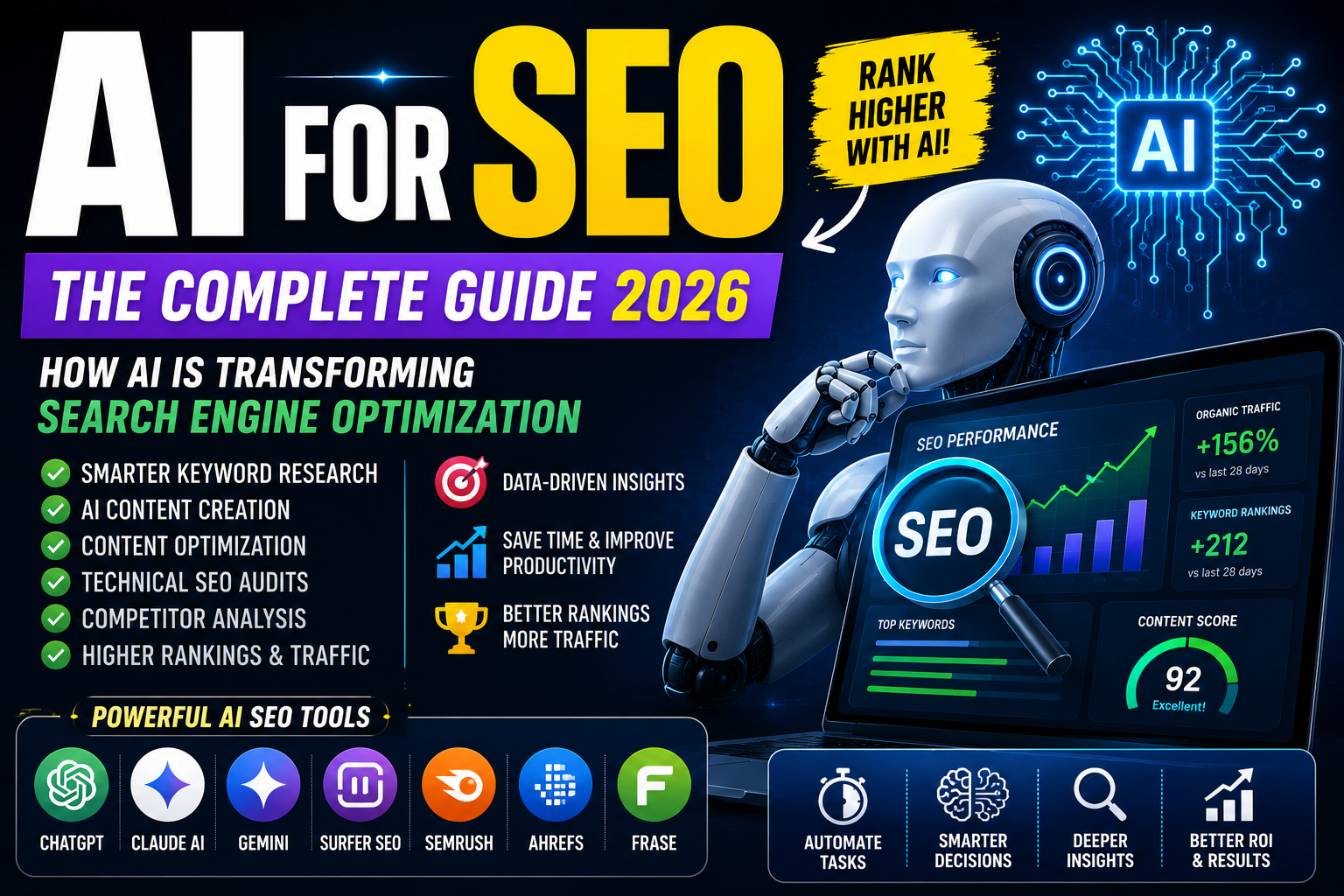
Introduction
Search Engine Optimization (SEO) has always been about understanding search engines, creating valuable content, and delivering the best user experience.
However, with the rise of Artificial Intelligence (AI), SEO is evolving faster than ever before.
Today, marketers, bloggers, businesses, and SEO professionals use AI-powered tools to perform keyword research, create content, optimize websites, analyze competitors, and improve search rankings.
AI is helping SEO professionals work smarter, save time, and make data-driven decisions.
In this guide, you'll learn how AI is transforming SEO, its benefits, applications, tools, challenges, and future trends in 2026.
What is AI for SEO?
AI for SEO refers to the use of Artificial Intelligence technologies to automate, improve, and optimize search engine optimization activities.
AI can analyze massive amounts of data, identify patterns, predict trends, and generate recommendations that help websites rank better on search engines.
Common AI-powered SEO tasks include:
✅ Keyword Research
✅ Content Creation
✅ Content Optimization
✅ Competitor Analysis
✅ Technical SEO
✅ Link Building
✅ SEO Audits
✅ Search Intent Analysis
The goal is to improve rankings, traffic, and user experience while reducing manual effort.
Why AI is Important for SEO
SEO has become increasingly complex.
Modern SEO requires:
Content creation
Technical optimization
User experience improvements
Search intent understanding
Competitor monitoring
AI helps simplify these processes.
Benefits include:
✅ Faster workflows
✅ Better insights
✅ Improved content quality
✅ Smarter decision-making
✅ Increased productivity
How AI is Transforming SEO
1. AI-Powered Keyword Research
Finding the right keywords is one of the most important SEO tasks.
AI tools can help identify:
High-volume keywords
Low-competition opportunities
Long-tail keywords
Search intent
Popular tools include:
Semrush AI
Ahrefs
ChatGPT
Surfer SEO
Benefits
✅ Faster research
✅ Better keyword targeting
✅ Improved rankings
2. AI Content Creation
AI can help generate:
Blog outlines
Articles
Product descriptions
Meta descriptions
FAQs
Popular tools:
ChatGPT
Claude AI
Gemini AI
Jasper AI
Benefits
✅ Faster publishing
✅ Consistent content creation
✅ Improved productivity
3. AI Content Optimization
Creating content is only part of SEO.
AI can optimize content for:
Keywords
Readability
Search intent
Structure
Popular tools:
Surfer SEO
Frase
Clearscope
Benefits
✅ Better relevance
✅ Improved user experience
✅ Higher ranking potential
4. Search Intent Analysis
Google increasingly focuses on user intent.
AI helps determine whether users are looking for:
Information
Products
Comparisons
Solutions
Understanding intent improves content quality and rankings.
5. AI-Powered Technical SEO
AI tools can identify technical issues such as:
Broken links
Slow page speed
Crawl errors
Missing metadata
Indexing problems
Popular tools:
Screaming Frog
Semrush Site Audit
Ahrefs Site Audit
Benefits
✅ Faster audits
✅ Better website performance
✅ Improved indexing
6. Competitor Analysis
AI can analyze competitors by identifying:
Top-performing pages
Keywords
Backlinks
Content gaps
This helps marketers discover new opportunities.
7. AI for Link Building
AI can assist with:
Outreach email creation
Prospect identification
Backlink analysis
Relationship management
Although human involvement remains important, AI can speed up the process.
Best AI SEO Tools in 2026
ChatGPT
Best for:
Content creation
SEO ideas
Keyword clustering
Meta descriptions
Claude AI
Best for:
Long-form content
Research
Content refinement
Gemini AI
Best for:
Research
Google ecosystem integration
Content planning
Surfer SEO
Best for:
On-page optimization
Content scoring
Keyword recommendations
Semrush AI
Best for:
Keyword research
Competitor analysis
SEO audits
Ahrefs
Best for:
Backlink analysis
Keyword tracking
Competitor research
Frase
Best for:
Content briefs
Search intent optimization
Benefits of Using AI for SEO
Save Time
AI automates repetitive tasks and research.
Improve Content Quality
AI helps create more comprehensive and relevant content.
Better Rankings
AI-driven optimization improves search visibility.
Increased Productivity
SEO professionals can focus on strategy rather than manual tasks.
Smarter Decisions
AI provides data-driven insights and recommendations.
AI SEO Workflow Example
Imagine you want to write a blog on:
"Best AI Tools for Marketers"
Step 1
Use AI for keyword research.
Step 2
Generate content outline.
Step 3
Write the article.
Step 4
Optimize with Surfer SEO.
Step 5
Generate meta title and description.
Step 6
Create social media promotion content.
This workflow can reduce hours of work.
Challenges of AI in SEO
Content Quality Issues
AI-generated content should always be reviewed.
Over-Optimization
Using AI incorrectly can lead to unnatural content.
Lack of Human Creativity
AI supports content creation but cannot fully replace human expertise.
Search Engine Guidelines
Google values helpful, high-quality content regardless of whether AI is used.
The focus should remain on providing value to users.
Future of AI in SEO
The future of SEO will become increasingly AI-driven.
Expected developments include:
🤖 AI Content Optimization
📈 Predictive SEO
🔍 Search Intent Modeling
⚡ Real-Time SEO Recommendations
🎯 Hyper-Personalized Search Results
📊 AI-Powered Analytics
Businesses that adapt to AI-powered SEO strategies will have a competitive advantage.
AI and Google's Future
Google itself is increasingly using AI through:
Search Generative Experiences
AI Overviews
Machine Learning Algorithms
Natural Language Understanding
SEO professionals must learn how AI influences search rankings and user behavior.
Who Should Learn AI SEO?
AI-powered SEO is valuable for:
✅ Bloggers
✅ Content Creators
✅ SEO Specialists
✅ Digital Marketers
✅ Business Owners
✅ Freelancers
✅ Agencies
Anyone looking to grow organic traffic can benefit from AI SEO techniques.
Final Thoughts
Artificial Intelligence is transforming SEO by making research, content creation, optimization, and analysis faster and more efficient.
While AI won't replace SEO professionals, it is becoming one of the most powerful tools in their toolkit.
The best results come from combining AI's speed and data-processing capabilities with human creativity, expertise, and strategic thinking.
As search engines continue evolving, learning how to use AI effectively for SEO will become an essential skill for anyone who wants to succeed online.
How are you using AI in your SEO strategy? Share your experience in the comments below!