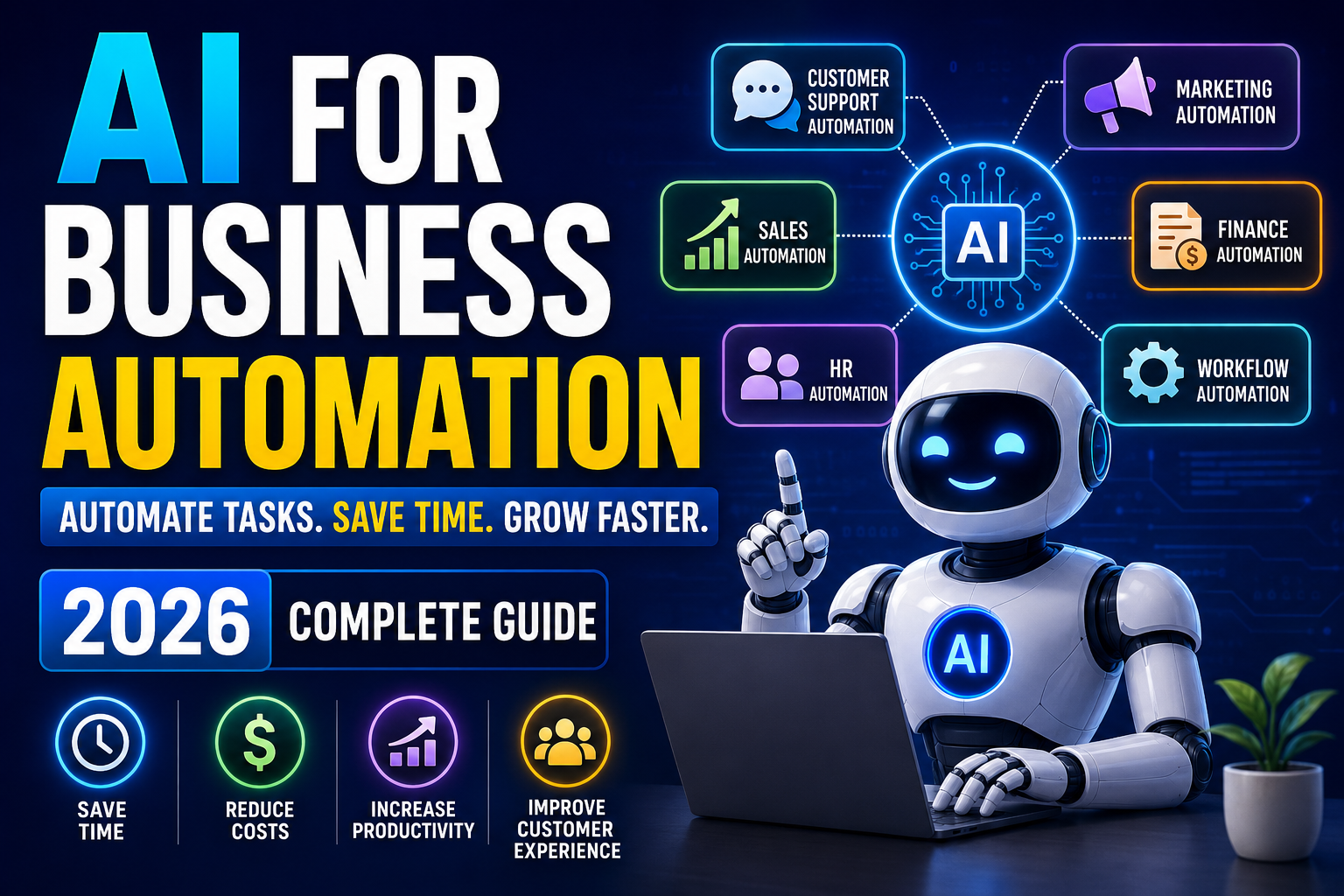
AI for Business Automation: The Complete Guide to Automating Your Business in 2026
Introduction
Artificial Intelligence (AI) is transforming how businesses operate. Tasks that once required hours of manual effort can now be completed automatically in minutes. From customer support and marketing to sales, HR, finance, and operations, AI-powered automation is helping companies increase productivity, reduce costs, and scale faster than ever before.
In 2026, businesses of all sizes—from startups and freelancers to enterprises—are leveraging AI automation to stay competitive in an increasingly digital world.
This guide explores how AI is revolutionizing business automation, the best tools available, real-world use cases, benefits, challenges, and future trends.
What is AI Business Automation?
AI business automation is the use of artificial intelligence technologies to automate repetitive tasks, decision-making processes, workflows, and business operations.
Unlike traditional automation, AI can learn from data, adapt to changing conditions, understand language, and make intelligent decisions without constant human intervention.
Examples include:
AI chatbots answering customer queries
Automated lead qualification
Smart email responses
AI-powered content creation
Invoice processing
Predictive analytics
Why Businesses Are Adopting AI Automation
Businesses are embracing AI because it offers:
Increased Productivity
Employees spend less time on repetitive tasks and more time on strategic work.
Cost Savings
AI reduces operational costs by automating processes that previously required human labor.
Faster Decision-Making
AI can analyze large datasets within seconds and provide actionable insights.
Improved Customer Experience
Businesses can provide instant support and personalized experiences 24/7.
Scalability
AI systems can handle thousands of interactions simultaneously without additional staffing.
How AI is Used in Business Automation
Customer Support Automation
AI chatbots and virtual assistants can manage customer inquiries around the clock.
Benefits:
Instant responses
Reduced support costs
Improved customer satisfaction
Faster issue resolution
Popular applications include:
Website chatbots
WhatsApp automation
Facebook Messenger bots
AI customer service agents
Sales Automation
AI helps businesses streamline their sales processes.
Capabilities include:
Lead qualification
Prospect scoring
Sales forecasting
Follow-up automation
CRM management
Sales teams can focus on closing deals rather than administrative tasks.
Marketing Automation
Marketing is one of the biggest beneficiaries of AI automation.
AI can automate:
Email campaigns
Social media posting
Content creation
Ad optimization
Audience targeting
SEO optimization
This improves marketing efficiency and return on investment (ROI).
Human Resources Automation
HR departments are increasingly adopting AI.
Applications include:
Resume screening
Candidate matching
Interview scheduling
Employee onboarding
Performance tracking
AI reduces hiring time and improves recruitment quality.
Finance and Accounting Automation
AI simplifies financial operations.
Examples:
Invoice processing
Expense management
Fraud detection
Financial forecasting
Payroll automation
This reduces human errors and improves financial accuracy.
AI for Workflow Automation
Businesses often use multiple tools that need to work together.
AI-powered automation platforms can connect:
CRM systems
Email platforms
Marketing tools
E-commerce platforms
Project management software
Examples include automatically:
Creating leads in a CRM
Sending welcome emails
Updating spreadsheets
Assigning tasks to teams
Best AI Automation Tools in 2026
ChatGPT
One of the most versatile AI assistants available.
Use Cases:
Content generation
Customer support
Email writing
Research
Business planning
Zapier AI
Zapier allows businesses to automate workflows between thousands of applications.
Benefits:
No-code automation
Workflow creation
App integrations
Process optimization
Make (Integromat)
A powerful automation platform for complex workflows.
Features:
Visual workflow builder
AI integrations
Advanced automation
Multi-step processes
Notion AI
Notion AI helps automate knowledge management and documentation.
Applications:
Meeting notes
Task summaries
Documentation
Content drafting
HubSpot AI
HubSpot integrates AI into sales, marketing, and customer relationship management.
Features:
Lead scoring
Email generation
CRM automation
Customer insights
Real-World Examples of AI Business Automation
E-commerce
AI automates:
Product recommendations
Customer support
Inventory management
Order tracking
Result:
Higher sales and improved customer experience.
Marketing Agencies
AI assists with:
Content creation
Ad copy generation
Social media scheduling
SEO analysis
Result:
More clients managed with fewer resources.
Healthcare
AI supports:
Appointment scheduling
Patient communication
Data analysis
Medical documentation
Result:
Improved operational efficiency.
Financial Services
AI helps with:
Fraud detection
Risk assessment
Customer support
Investment analysis
Result:
Faster and more accurate decisions.
Benefits of AI Business Automation
Save Time
Tasks that once required hours can be completed within minutes.
Reduce Errors
AI follows predefined rules and reduces human mistakes.
Improve Efficiency
Workflows become faster and more consistent.
Increase Revenue
Better customer experiences and optimized operations lead to business growth.
Enhance Customer Satisfaction
Customers receive quicker responses and more personalized interactions.
Challenges of AI Automation
Despite its advantages, businesses should consider:
Initial Setup Costs
Some AI systems require investment and implementation time.
Data Privacy Concerns
Businesses must protect customer and organizational data.
Employee Adaptation
Teams need training to effectively work with AI systems.
Quality Control
Human oversight remains essential for critical decisions.
Will AI Replace Employees?
AI is designed to automate repetitive tasks, not replace human creativity, leadership, and strategic thinking.
Employees who learn to work with AI will become more productive and valuable.
The future workplace will combine human expertise with AI-powered efficiency.
Future of AI Business Automation
The next generation of AI automation will include:
Autonomous AI agents
Predictive business intelligence
Voice-controlled workflows
Hyper-personalized customer experiences
AI-powered decision-making systems
Businesses that adopt AI early will gain a significant competitive advantage.
Conclusion
AI business automation is no longer optional—it's becoming a necessity for modern organizations. By automating repetitive tasks, improving decision-making, and enhancing customer experiences, AI helps businesses operate more efficiently and scale faster.
Whether you're a startup founder, freelancer, agency owner, or enterprise leader, implementing AI automation can save time, reduce costs, and unlock new growth opportunities.
The businesses that embrace AI today will be the leaders of tomorrow.