AI for Business Automation: Complete Guide to Automating Your Business with Artificial Intelligence in 2026
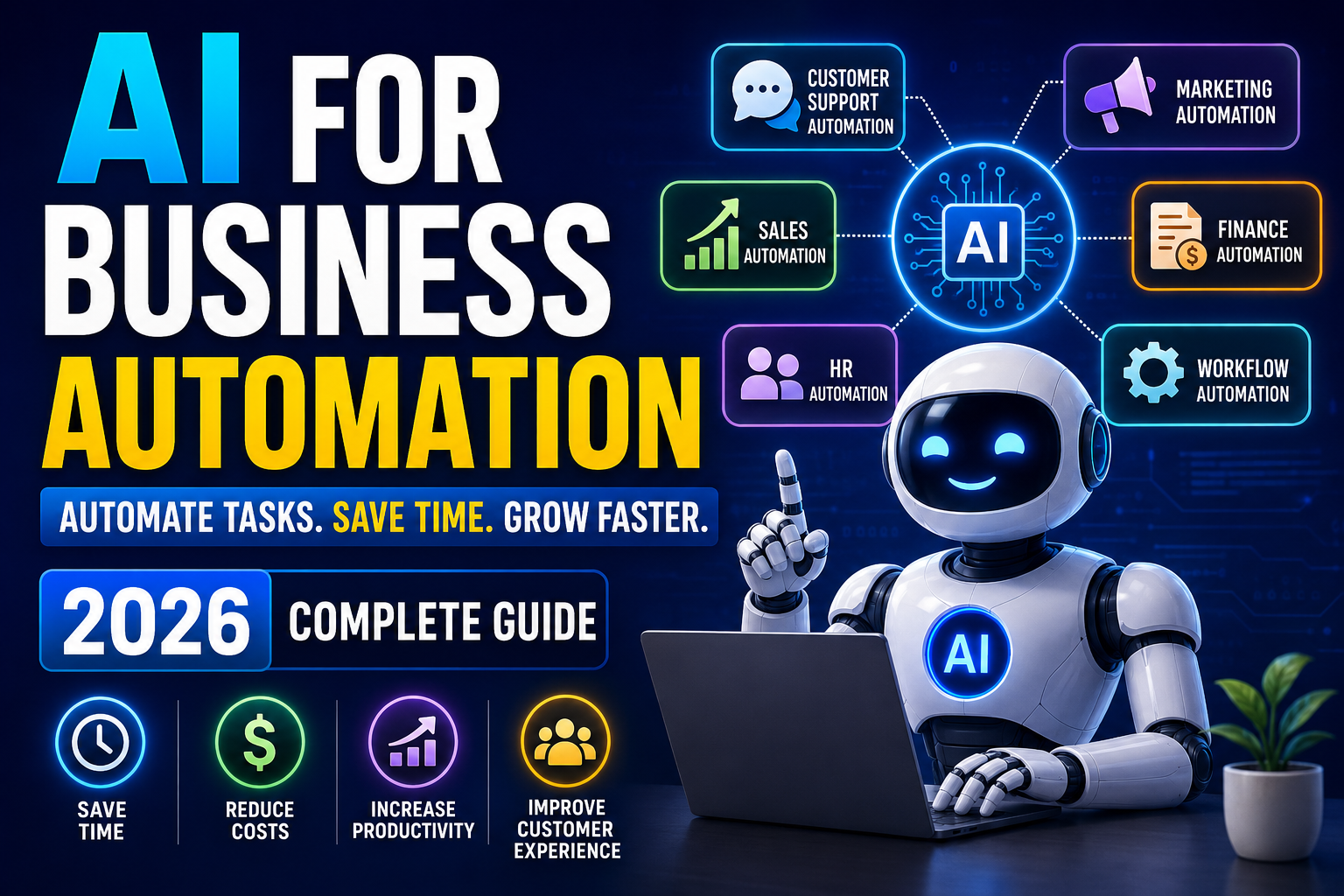
Introduction
Running a successful business involves countless repetitive tasks—from responding to customer inquiries and managing emails to processing invoices, generating reports, and analyzing data. These tasks consume valuable time that could be spent on strategy, innovation, and business growth.
This is where Artificial Intelligence (AI) is transforming the modern workplace.
AI-powered business automation enables organizations to automate routine processes, reduce operational costs, improve efficiency, and deliver better customer experiences. Whether you're a freelancer, startup founder, small business owner, or enterprise leader, AI can help streamline operations and increase productivity.
In this guide, you'll learn what AI business automation is, how it works, its benefits, popular tools, real-world use cases, and how businesses can successfully implement AI in 2026.
What is AI Business Automation?
AI Business Automation refers to using Artificial Intelligence technologies to automate repetitive business tasks and workflows with minimal human intervention.
Unlike traditional automation, AI can:
Learn from data
Understand natural language
Make intelligent decisions
Adapt to changing conditions
Improve over time
AI helps businesses automate processes while maintaining accuracy and efficiency.
Why AI Business Automation Matters
Businesses face increasing challenges such as:
Rising operational costs
Limited workforce
Customer expectations
Large volumes of data
Repetitive manual work
AI helps overcome these challenges by:
✅ Saving time
✅ Reducing costs
✅ Improving accuracy
✅ Increasing productivity
✅ Enhancing customer satisfaction
How AI Business Automation Works
The automation process typically follows these steps:
1. Data Collection
AI gathers information from:
Emails
CRM systems
Websites
ERP software
Customer interactions
Databases
2. Data Analysis
AI analyzes information to identify:
Patterns
Customer behavior
Business trends
Operational inefficiencies
3. Decision Making
Based on predefined rules and machine learning models, AI recommends or performs actions automatically.
4. Task Automation
AI executes tasks such as:
Sending emails
Updating databases
Scheduling meetings
Processing invoices
Generating reports
5. Continuous Improvement
Machine learning enables AI systems to improve performance over time.
Benefits of AI Business Automation
Increased Productivity
Employees spend less time on repetitive work and more time on high-value activities.
Cost Reduction
Automation reduces labor costs and minimizes operational expenses.
Better Accuracy
AI significantly reduces human errors in repetitive processes.
Faster Decision Making
Real-time analytics help businesses respond quickly to changing conditions.
Enhanced Customer Experience
AI enables faster support and personalized customer interactions.
AI Applications in Business Automation
1. Customer Support
AI chatbots provide:
24/7 support
Instant responses
FAQ handling
Lead qualification
Popular tools:
ChatGPT
Intercom AI
Zendesk AI
Drift
2. Email Automation
AI helps businesses:
Draft emails
Categorize messages
Schedule follow-ups
Generate responses
Popular tools:
Gmail AI
HubSpot AI
Microsoft Copilot
3. Marketing Automation
AI assists with:
Social media scheduling
Content generation
Email campaigns
Ad optimization
Customer segmentation
Popular tools:
HubSpot
Mailchimp AI
Buffer AI
Canva AI
4. Sales Automation
Sales teams use AI for:
Lead scoring
CRM updates
Sales forecasting
Proposal generation
Popular platforms:
Salesforce Einstein
HubSpot CRM
Zoho CRM AI
5. HR Automation
AI streamlines:
Resume screening
Candidate matching
Interview scheduling
Employee onboarding
6. Finance Automation
Finance departments automate:
Invoice processing
Expense management
Budget forecasting
Financial reporting
7. Inventory Management
Retail and eCommerce businesses use AI to:
Predict demand
Monitor inventory
Optimize supply chains
Reduce stock shortages
8. Business Intelligence
AI analyzes company data to provide:
Performance dashboards
Revenue forecasts
Customer insights
Market trends
Best AI Business Automation Tools in 2026
ChatGPT
Best for:
Content creation
Customer support
Documentation
Business planning
Microsoft Copilot
Best for:
Office automation
Excel analysis
Email drafting
Productivity
Google Gemini
Best for:
Google Workspace
Research
Meeting assistance
Document creation
Zapier AI
Best for:
Workflow automation
App integrations
Task automation
Make (formerly Integromat)
Best for:
Advanced business workflows
Automation scenarios
API integrations
Notion AI
Best for:
Knowledge management
Documentation
Team collaboration
HubSpot AI
Best for:
Marketing
CRM automation
Sales management
Real-World Examples
E-commerce
AI automates:
Product recommendations
Customer support
Inventory updates
Order tracking
Marketing Agencies
AI automates:
Social media posts
SEO optimization
Client reporting
Content creation
Healthcare
AI helps with:
Appointment scheduling
Medical documentation
Patient support
Banking
AI automates:
Fraud detection
Customer service
Risk analysis
Loan processing
Challenges of AI Business Automation
Despite its advantages, businesses should consider:
Data Privacy
Protect customer information and comply with regulations.
Initial Setup
Automation requires planning and implementation.
Human Oversight
AI should support—not completely replace—human decision-making.
Employee Training
Teams need training to work effectively alongside AI.
How to Start Using AI in Your Business
Step 1
Identify repetitive tasks.
Step 2
Choose the right AI tools.
Step 3
Automate one workflow at a time.
Step 4
Monitor performance and optimize.
Step 5
Expand automation gradually.
Future of AI Business Automation
The next generation of AI automation will include:
🤖 AI Agents
⚡ Autonomous Workflows
📊 Predictive Business Intelligence
🧠 Smarter Decision-Making
🔗 End-to-End Workflow Automation
Businesses adopting AI early will gain significant competitive advantages.
Who Should Learn AI Business Automation?
AI automation is valuable for:
✅ Entrepreneurs
✅ Business Owners
✅ Startups
✅ Freelancers
✅ Marketing Agencies
✅ Operations Managers
✅ HR Professionals
✅ Sales Teams
Anyone looking to improve efficiency and scale operations can benefit from AI automation.
Final Thoughts
Artificial Intelligence is no longer just a productivity tool—it's becoming the foundation of modern business operations.
By automating repetitive tasks, improving decision-making, and enhancing customer experiences, AI enables businesses to focus on growth, innovation, and long-term success.
Whether you're managing a small startup or a large enterprise, adopting AI business automation today can save time, reduce costs, and provide a powerful competitive advantage.
The future belongs to businesses that combine human creativity with AI-driven efficiency.
How are you using AI to automate your business? Share your experience in the comments below!